New Language, New Self?

Me: “Hey William. To continue the discourse on Twitter.. It’s like, to the extreme part, languages reflects different ‘selves’. Misalnya imej lo ketika pake bahasa sama pake English jadinya beda.”

Will: “TRUE. A different persona indeed. But is this more to the written or oral side? Or both? In oral  the proficiency of the language also affects the persona you put on with that language. Actually the same goes with written, but oral shows the persona more clearly.”

Me: “In my theory, proficiency of the language is a prerequisite to actually have that ‘new self’. And yes it covers both written and oral form. So once you really master a language, you’ve created a new self.”

Will: “But another observation I made. Yes that’s true because the thinking process in every language is different as you stated. But in my case I am fluent in both bahasa and English. Jadi saya bisa menggunakan ‘self’ English saya dalam Bahasa. Dan sebaliknya. Seakan dua persona ini berasimilasi.”

Me: “No no no. The approach you’re using is a persona-centered. My approach is more language-centered.”

Will: “And the difference between them?”

Me: “…In which I’ve stated that ‘each and every language is linked to a certain history and paradigm’. Words that you have in English aren’t commensurable in Indonesian. Thus, the self you reveal in English can’t be fully ‘revealed’ in other languages. So…languages are like different windows in a house. You can only see certain parts/rooms from one window and other parts from other windows. I hope you get what I mean…”

Will: “I agree. But that is theory.”

Me: “That is.”

Will: “Sorry I meant that theory has more intricate factors behind it.”

Me: “That’s true. ‘Intricate factors’. Apa itu istilah di ekonomi…ceteris paribus ya. Teori berlaku ketika faktor lain dianggap sama.”

Will: “In a way I can’t really put up an argument since I agree with you. You can speak other languages such too right besides English and Indo. I have an okay proficiency in Japanese and Mandarin; and yes the language can’t be fully revealed in another language. So I fully agree and can’t really put up a fight but I’ll try.”

Me: “You don’t have to, you know. Better save the energy for whatever you’re doing in campus today -.-“

Will: “Lol I actuallly have work. So it’s a wrap then.”

Me: “Err okay.”

Will: “It’s just that from a personal experience I know that there is a different ‘self’. What that self is and the difference between the two I only have an outline of it, but I can’t fully comprehend what it is.”

Me: “I feel like Keohane being criticized by Cynthia Weber.”

Will: “Lol what is that?”

Me: “IR scholars who really like to rebut each other even when they aren’t really opposing the other’s argument.”

Will: “Anyway yes so there’s self A and B for example. It’s just the nature. Since I have mastered both languages I can consciously swap them both. I have a clear outline on what both of these selves are but it comes real close. And there is a default self that shows when you use either language.”

Me: “True.”

Will: “It wouldn’t be quite the same when using Indo with the English self. This requires an very fine understanding of your inner capabilities in both languages.”

Me: “See? You’re using a person-standpoint. Just like what you say, thinking process takes different ways in different languages. You can’t really distinguish the ‘self’ when you’re inside the ‘house’. But for language observers you’ve become a (probably not totally but) different person.”

Will: “That’s why I said from a personal experience. I fully agree with what you’re saying though.”

Me: “Now expressions, sentences, and metaphors are different in each language.”

Will: “Metaphors are true to each language and might not work in the other. Although not to the precise bulls-eye if translated, that lack of 100% is substituted to a 75-95% accuracy.”

Me: “Now that’s the thing. ‘Not to the precise bulls-eye if translated’. The way your environment perceives you will change as the language you use changes. I’m not rebutting at all. It’s just…you might see the same things from different windows; but with different angle, the…’understanding’ might be 95% similar yet your point of view will differ.”

Floor-and-windows_1332_19473791_0_0_7011429_300

(with more windows, more light can come in, and easier for you to show what’s inside–only if you aim to)

Will: “Yep true. Yes. To add on that the cultural differences also affect the understanding.”

Me: “True! Cultural differences contribute to a certain language’s frame of reference.”

Will: “And a more intricate detail? In oral the tone used also affects a lot. And probably more than what the words really mean.”

Me: “Haven’t really observed that. But come to think of it, true. Are we done with the Keohane-Cynthia rebuttals now? Have a good day!”

Will: “Haha it’s good to share thoughts and experiences. But anyway yeah have a good day. I’m late for work nooooooo.”

Me: “Hahaha good luck with that.”

Sing These Kick-Ass Lines

“I don’t listen to songs…I read their lyrics.” –Melissa Indria Pertiwi

Truth be told, I didn’t really perceive myself as a ‘lyrics-reader’ until I read such sentence on a friend’s blog. By that time, I realized why, most of the times, my friends don’t enjoy songs that I dearly do. I mean, I feel good listening to Bruno Mars, Michael Buble, or Rihanna, and more to follow, but I’m not necessarily absorbed by the song. I just don’t. Then I discovered the reason: it’s the lyrics!

So, in a quest of geeks-with-similar-thoughts, I’ll share my five best songs (all of them are pretty much induced with perplexing metaphors):

1. A Beautiful Mess – Jason Mraz

Jason-mraz

You are strong but you’re needy, humble but you’re greedy
Based on your body language and shoddy cursive I’ve been reading
Your style is quite selective, though your mind is rather reckless
Well I guess it just suggest that this is just what happiness is

Hey, what a beautiful mess this is
It’s like picking up trash in dresses

The lyrics itself–can’t find a better phrase to describe–is a beautiful mess. Some people may need to take another angle in ‘seeing’ these lines in order to understand their truest beauty (if not handsomeness), yet once they do, they’ll get intoxicated. Like a maze in which you wish to get trapped forever.

2. Like A Star – Corinne Bailey Rae

Corinne_bailey_rae_-_like_a_star_single_cover

Just like a star across my sky
Just like an angel off the page
You have appeared to my life
Feel like I’ll never be the same
Just like a song in my heart
Just like oil on my hands
Honored to love you

I always admire Corinne and how she puts clouds that I have in mind into vivid, concrete lines. From all possible personification you may use to describe a guy you fall in love with, ‘oil in my hands’ would hardly pop up. Yet this amazing British girl is simply different.

3. The Man Who Can’t Be Moved – The Script

The-script-the-man-who-cant-be-moved

Going back to the corner where I first saw you
Gonna camp in my sleeping bag, I’m not gonna move
Got some words on cardboard, got your picture in my hands
Saying if you see this girl, can you tell her where I am

People talk about the guy
Who’s waiting on a girl, oh whoa
There are no holes in his shoes
But a big hole in his world

One of the hardest thing that a man should do, to my shallow observation, is to admit that they’re weak. So weak that they’re afraid to move on from a girl they used to be in so very love with. Yet The Script wrapped it all subtly in a song that tells the listener (or I’d prefer reader) how they really feel without actually showing how soft their heart is. A gentle warrior holding on in a battle they know they already lost. Deep.

4. Thinking of You – Katy Perry

519ltcqcpol

Comparisons are easily done once you’ve had a taste of perfection
Like an apple hanging from a tree, I picked the ripest one I still got the seed
You said move on, where do I go?
I guess the second best is all I will know

You’re like an Indian summer in the middle of the winter
Like a hard candy with a surprise center
How do I get better once I’ve had the best
You said there’s tons of fish in the water so the water I will test

Even without the strong story (of a woman whose husband died in a war and had to struggle with a new man in her life) attached to this song, I can already sense the ‘grandiose-ness’ of its lyrics. So far this is the best potion-of-words Katy can ever come up with. The soft images it stimulates your mind with, the pain it induces your heart with, and the relieved feeling you’ll get afterwards. Priceless.

5. My Today – D’Sound

Df2ab8d512f0

And I love you, my today
And I love you, my tomorrow
And I forgive you, yesterday
For the treachery and evil ways
I love you my, I love you my today

A song I dearly treasure for days when I doubt if I deserve what I have and if I deserve to wish for things I don’t have. A plainly beautiful song to let go. To love your today, tomorrow, and to forgive yesterday. Indescribable.

That’s it for now. Make sure you have these songs on your playlist!

Places to Go Before I Die

You know that period when you’re getting too old to do anything and rich enough that you can go anywhere? When that point of my life comes, I’ll make sure that I’ll go visit these places (hopefully with a company who has the same ardent interest):

1. (At least one of) Harvard Libraries

Librarie-of-harvard

A perfect place for bibliophiles! Harvard University has 70 different libraries (woot!) that form its system. At Harvard University, most of the libraries are not available for public use at all. (So, the thing is, I have to be a Harvard student to get here) With a large number of resources, both on the Internet and through the actual library, Harvard University is known to have one of the best university libraries in the country. Harvard University has separate libraries for many different subjects including theology, philosophy, mathematics, science, and music.*
(http://www.mnlibrary.org/libraries-of-harvard-and-georgetown.html)

2. Musee du Louvre

3-musee-du-louvre-brian-jannsen

It’s the building where ‘Potrait de Lisa Gherardini’ and other >35,000 works of art sleep everynight!The Louvre, in its successive architectural metamorphoses, has dominated central Paris since the late 12th century. Built on the city’s western edge, the original structure was gradually engulfed as the city grew. The dark fortress of the early days was transformed into the modernized dwelling of François I and, later, the sumptuous palace of the Sun King, Louis XIV. Here we explore the history of this extraordinary edifice and of the museum that has occupied it since 1793.*
(http://louvre.fr)

3. The Wizarding World of Harry Potter

Concept_photo_of_The_Hogwarts_Castle_(Exterior)

It’s been a public secret that I’m one of those Hogwarts freakos, and what place would you expect I would go to? I mean, they got HOGSMEADE AND HOGWARTS AND THE REAL BUTTERBEER?! (okay I got too excited). Truth be told, I wouldn’t wait THAT LONG to go here. I’ll make sure I’ll go here in my 20s, or 30s at the very last. Amen!
(http://www.universalorlando.com/harrypotter)

4. Alaska

October 12, 2012 Aurora Borealis (or Northern Lights) viewed from Prominence Point, Anchorage, AK.

Who would die before witnessing Aurora Borealis with their own eyes? When night is dark enough in September to April, you’ll be able to watch one of God’s greatest designs there in Alaska! There are probably more reasons to visit this special territory of the United States, yet for the time being aurora is my only reason. (http://www.pfrr.alaska.edu/aurora/index.html)

Those are my version of “Places to go before I die”, care enough to share yours?

Being Creepy Is Alright

Do you have something (an activity or subject) that really, really excites you even when you only ‘think’ of doing it without actually doing it?

I do.

People name it inter-language study, I name it ‘the beauty of language enigma’. The process of discovering uniqueness of expressions, grammatical structures or metaphors in a certain language and how they aren’t present in other languages is simply spellbinding. I’m addicted to traveling into different dimensions where each and every word has a history standing behind it, an (borrowing Thomas Kuhn’s term) ‘incommensurable’ frame of reference that has no comparable ally.

That isn’t what I want to point out in this post, though.

I happened to stumble upon a random ‘motivational’ TV program on which the (aged yet handsome) host talked about ‘finding your true passion’. A classic debate that previously didn’t matter to me. Tell you what, it apparently does.

Out of 10 people who read this post, only 3 of them know what their passion is. Worse, only 1 of them strives and works in accordance with this passion.

Now which one of them are you? The unfortunate 7 or the semi-fortunate 3? I hope that you’re the rare 10%.

Tumblr_lf6dvg41mk1qb1pfxo1_500

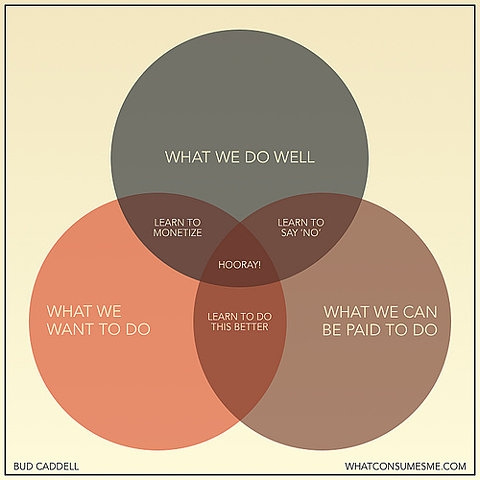
You may also refer to this Venn diagram for a healthier career.

I consider myself as one of the big three. I mistook international relations as my major yet am lucky enough to have plenty opportunities to live my passion independently on the sidewalk. Am also grateful that the main road I’m taking is surprisingly very enjoyable. No regrets, no.

Now what does passion have to do with your life? How would ‘knowing passion’ benefit you?

Imagine a bike rider. Imagine him aimlessly pulling the pedal with no certainty of where he wants to go to. Or, at the very least, where he ‘should’ go to. He’s got the bike and energy to spend, but not a destination.

Imagine another bike rider who craves for going to the mountain. Imagine him, equipped with enough information of how to get there, preparing tools to efficiently accomplish his goal. He might not have everything that he requires at present, but the intention can drive him to get focused on what he wants to achieve.

See. Your passion may not be your (current) profession (always believe that there might be a turning point in the end of this road). Nor must it be something you’re really good at. But just to have it is like finding out a hidden, everlasting source of energy to feed your soul!

Some people overrate obsession and misunderstand it as passion. They pretend, or they assume that there is this certain adrenaline rush of exhileration when they actually don’t. You may take that as a positive mistake with many bright-sides, yet don’t forget that the shine is very likely to blind you in finding your true passion.

I hate when people misuse (if not abuse) the word ‘passion’ in rethorical sentences. To me passion does matter. When you talk passionately, your face becomes more radiant than ever. Passion has the magic to keep you awake for hours doing a single thing. Passion matters. It really does.

Passion may turn you into some creepy, ununderstandable geek. But that’s just alright. (Seven of you may not comprehend this notion at all, three would nod in doubt, and one last, luckiest one would close their browser tab smiling.)

I Wish I Could Be Indonesia’s Atatürk

Hosni Mubarak managed to change Egypt’s law of divorce in 2000. The German once used deutsche mark to buy goods until 2002 when the government set Euro as their official currency. People cursed smoking habit until handsome actors lighted up their cigarettes on Hollywood movies in the 80s. These facts have proven that law, currency, and mindset of a certain community are not impossible to change. What about language?

Kemel-ataturk-introduces-language-reform

The most difficult shift that may happen to any society, I must say, is a language reform. Most nations prefer to not attempt for such a crazy idea; those who do, usually prefer a gradual approach. However, under this incredibly charismatic guy, Mustafa Kemal (later named after Ataturk, meaning the father of Turks) Turkey undertook the modern world’s swiftest and most extensive language reform in 1928. The exact same year when our youths vowed in Sumpah Pemuda to speak with a single national language, Bahasa Indonesia. Although we aimed for what Ataturk also did,
the final output was not any similar.

What happened in Turkey?

1) Ataturk replaced Arabic scripts with Latin ones.
The letters had been used by the Turks for a thousand years, yet within merely FIVE MONTHS, Ataturk accomplished this major breakthrough. Talking about, uhm, ambitious guys. As the 1920s came to an end, Turkey had fully and functionally adopted 29 (adjusted) Latin alphabets without the complexities of the Arabic script. Children and adults were then able to read and write within a few months, and studying English became more effective than ever.

2) He eliminated borrowed grammatical devices from the Arabic and Persian.
Which used to hold a tight grip over the Ottoman Turkish. He (and his team, I believe) incorporated a whole new 4-tenses grammar system: geçmiş zaman, şimdiki zaman, gelecek zaman, and geniş zaman.

3) Thousands of vocabularies.
He substituted the loan words from foreign languages with a large number of original words, introduced provincial expressions, as well as revived the almost-extinct old Turkish phrases.

The transformation met with unparalleled success:
In the 1920s, the written language consisted of more than 80 percent Arabic, Persian, and French words; by the early 1980s the ratio had declined to a mere 10 percent. WHAT THE, MAN, WHAT THE!

Ataturk’s language reform–and that includes all the three instruments–has been one of the most far-reaching in history. It has overhauled Turkish culture and education. So yeah, people, you may now start worshiping this cool guy.

What about Indonesia?

I was lucky to have stumbled upon “Bus Bis Bas: Berbagai Masalah Bahasa Indoensia” by Ajip Rosidi which gives me a lot of I-thought-I-was-the-only-person-on-earth-who-believed-so! moments. If I may excerpt the whole book into a single sentence, then it should be this: He criticizes Indonesian ruler’s lack of consistency in creating the system of Bahasa. What Mr Suwandi and his fellow Balai Pustaka friends tried to do was, more or less the same like what Ataturk’s squad attained, yet resulted an utterly different product for their blurred intentions.

First of all, we have to acknowledge that–unlike our Turk brothers whose aim was to ‘purify’ their language from borrowed terms and help new learners–Indonesian people comprises hundreds of different tribes and their regional languages (not to mention dialects). EYD (Ejaan Yang Disempurnakan) was then invented to unify voices and ideas of the whole country. Then what’s wrong in this perfect scheme? Consistency, my friends, consistency.

1) Okay, they turned all ‘tj’ into ‘c’ and ‘oe’ into ‘u’ (ejaan Suwandi, a replacement to ejaan Ophuysen). This is basically easy and acceptable, right? But then, they left a flaw by creating an article on the rules which says that ‘name-spellings are based upon the owner’s discretion’. This leaves Mochtar Lubis, Suwardi Tasrif, Asrul Sani, Usmar Ismail, and Maria Ulfah voluntarily changed their names, but Roeslan Abdulghani and Pramoedya Ananta Toer sticked to their old spellings. Now many people are confused in writing down ‘Soekarno’/’Sukarno’, ‘Nasution’/’Nasoetion’, etc.

2) There was a notion to adopt both e (weak-e in elang) and é (strong-e in ember) in the Bahasa in order to not mislead people since Indonesian letters are basically set to be read in the way it’s written. The idea was then tabled-off for a silly question of ‘tidak ada mesin ketik yang berhuruf demikian’. Err–okay, Sir, we’re talking about setting a language which is gonna be used by hundred millions of people, and you worry about what? Typing machine? Turkish and Vietnam people, for comparison, are proud to have their own keyboards with extra letters as long as it does not hamper the way they use their language. Today, people hardly know if telepon should be pronounced telepon or télépon and if ide should be pronounced ide or idé.

3) They insisted on adopting foreign words in Indonesian-yet-based-on-English spelling. The case of ‘sistem or sistim’ has been very intriguing to my eyes. ‘Sistim’ was derived from a Dutch word ‘systeem’, yet it’s now converted to ‘sistem’, reflecting on how the English spell it. Weird. It’s like you’ve adopted a child to your family and then gave him back to his family because you didn’t like the family? What, again?

There are still a lot of incredible thoughts which he kindly shares through the book, but I guess I’ll have to rest the case here. The point is, I wish our Balai Pustaka people could’ve been a little more serious and effortful in doing their duty to set rules and guidance for our baby language, and I’m pretty much disappointed to the fact that they didn’t.

I wish I was born way earlier, became a great linguist, hired as one of those EYD setters, and created history like Ataturk did. I wish.