Words of the Year (2013)

If you happen to be one of Conundrum’s earliest readers, chances are that you have read my summaries of 2011 and 2012 already. I did them mainly because I over-enjoyed retrospective contemplation—not to mention the functionality aspect of it: these posts really help me look at the bigger picture of who I really am, and feel quite significantly more grateful about it.

Now Kundera insisted on the (unbearable) lightness of being—he tried to convince us that when things don’t repeat, they sort of evaporate and float, if not vanish, to the air. It is exactly ‘reoccurrence ‘ that keeps memories heavy enough to stay on the ground. It is repetitions, not mere discussions about them, that sustain history as a reality before humans. Anthropologists however, would probably argue that events don’t gain weigh as they happen again, they simply become a tradition.

Am I trying to give a third shot to a plausibly long-term ritual, or is this only an effort to answer Kundera? I’m not particularly sure. Either way, I’m assuming that you aren’t entirely happy about having another carousel round—which leads me to take the cheesy road for the sake of offering something different this year: 13 words that can help describe my 2013 (mostly taken from Adam Jacot de Boinot’s The Meaning of Tingo). Might get a little sentimental and lengthy on the way, I worriedly hope you don’t mind.

1. Yerdengh-nga

1. Yerdengh-nga (Wagiman, Australia), v. “To clear off without telling anyone where you are going.”

I began the year leaving on a 5-month scholarship to the Island of Lions, and for the first time in my 20 years of life, I understood what ‘missing’ actually meant—in its most naked, honest sense. I remember spending my last day in Bogor crying myself off to sleep as it became clear to me how much I cared about my family and friends, how their presence mattered more than I ever realized (I was emotionally slow—probably still am). I didn’t regret the decision though, I did need to withdraw myself from the status quo—wasn’t sure where I was headed to, but I knew I could use some clear-cut beginning and a fresh start as a complete stranger in a country of introverts.
2. Hiraeth

2. Hiraeth (Welsh), n. “A feeling of sadness, somewhere between homesickness and nostalgia.”

As a consequence, though, I had to deal with hiraeth—a great deal of hiraeth (it was never in my dictionary before). I wasn’t in an exactly perfect shape to make new friends—Mr. Thesis kept on calling my name every time I spent too much time hanging out with them—so I had to settle down with a little loneliness in the libraries. I gave up expecting anything on January 25th, but to my surprise, I had a really good time: a lunch treat by a cool professor, a home-made dinner by Agi, presents from him, Shieron, Iip, and my roommate Chontida—even Kiki and Stefi came over with a real birthday cake! For the first time in my early weeks away from home, I felt content.

3. Tuti’i pas ayina

3. Tuti’i pas ayina (Persian), n. “A person sitting behind a mirror who teaches a parrot to talk by making it believe that it is its own likeness seen in the mirror which is pronouncing the words.”

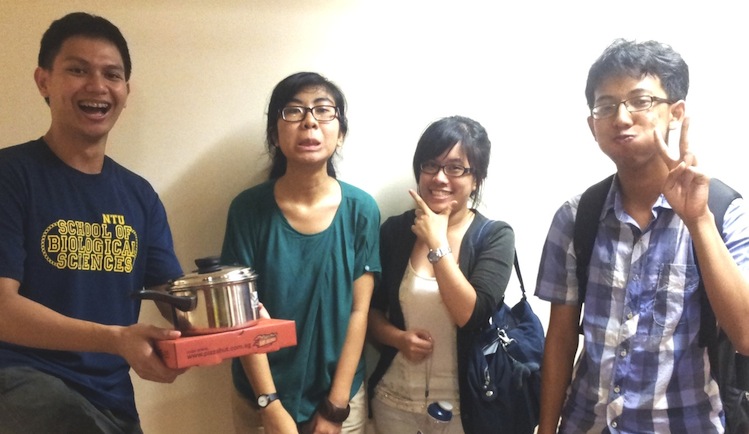
One of the bright peeps above might sue me by equating them to parrots (LOL), but this Persian word impeccably represents what Diku, Fahmi, and I (a.k.a. the Evil, Human, and Angel coaches—HAHAHA) had been trying to do with them: to make them see what we saw, that they had the potential to grab the awards we’ve all been waiting for. They say three is the charm, but apparently we had to lose again. Despite completing the hattrick though, I gained many valuable lessons just by accompanying them preparing for and going through the War. So thank you, kids.
4. Lele kawa

4. Lele kawa (Hawaiian), v. “To jump into the sea feet first.”

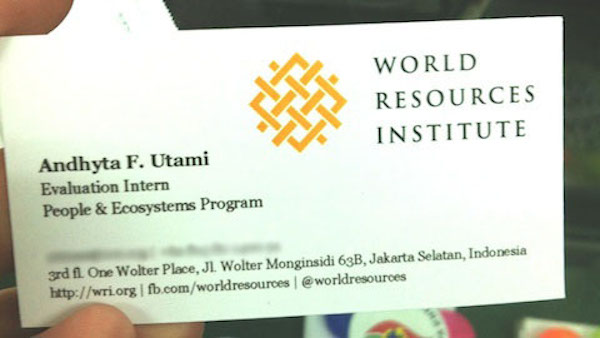
It will be a complete lie to say that I knew what I was doing when I applied an internship position at the awesome think-tank where I ended up being offered a full-time post at. In Hawaiian, people would say that I lele kawa-ed: I wanted to swim but was still afraid of the depth of the water and all. Regardless, this was my first professional business card (I’m now a research assistant) and needless to say I was quite proud about it without any particular reason. I guess it was a simple satisfaction of finally being hired and making actual impacts on the ground.
5. Ai bu Shi

5. Ai bu shi shoo (Chinese), adj. “So delighted with something that one can’t keep one’s hands off it.”

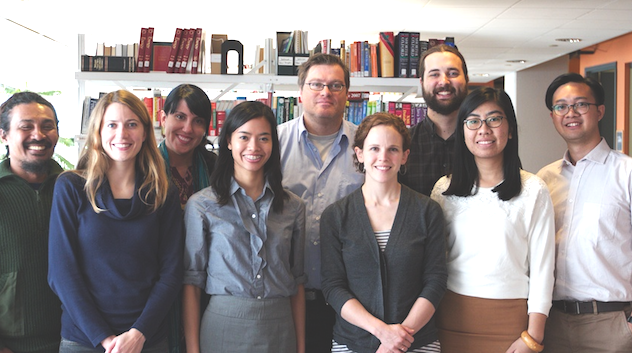
Past the lele kawa period, came the ai bu chi shoo phase of working. Today, having worked over 8 months for the institute and experienced many rare opportunities from it (including being involved in the Riau forest fires episode and actually flying to Washington, D.C. to meet all the awesome geeks and researchers there), I should say that randomly applying for the internship was one of the best decisions I made in 2013. This is a pretty new team picture of the Indonesia team taken at the office.

image

6. Kapusta (Russian), n. “Money (literally, cabbage).”

I hesitated to pick this word because somehow, I was afraid to admit that to a certain extent I am just as materialistic as people I typically hate are. A better word to describe what I’m trying to say is probably ‘afford’ but that’s English, so I had to go with ‘cabbages’ instead :)) Bottomline: I simply have to brag about how good it felt to afford a life of your own, making your own cabbages and spending them as you please (especially if you make four digits per month). I’ve also been blessed with the luxury of making my family a little happier with the small stuff I can provide them with. What I now have to learn about is to keep myself grounded: to truly understand that I do not, in any way, reserve the right to be selfish and annoying just because I grow my own cabbages.

(No, btw I did not buy the sweet-looking Beetle. My friend and I just rented it for our SF-LA trip.)
Screen Shot 2014-01-13 at 11.24.54

7. Boghandel (Danish), n. “Bookshop.”

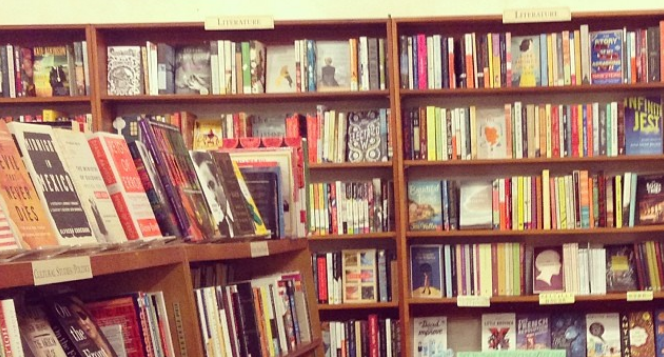
Now one of the good things about having lots and lots of cabbages is that I can buy a loadful of books (insert a huge grin emoticon here). To nobody’s surprise, this year I hit a new record of the number of books I managed to take home. I got almost another one every three days, and barely finish one of them every week. In economics, Rocky would say, this is called over-supply problem. In my language, however, I call this ‘over-blessing’. You are welcome to visit my soon-to-be library!
8. IAUg

8. Mokita (Kiriwana, Papua New Guinea), n. “The truth that all know but no one talks about.”

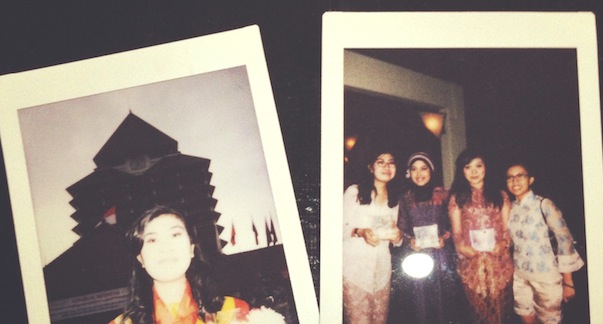
As you might have realized, I finally finished 3.5 years of academic experience in the beloved campus (stole half a year on the Singaporean escapade). Surprisingly though, the day I actually wore my bright-orange toga, I hardly felt anything. I was pretty sure I was happy, somehow, because all the people I loved were actually there: the whole nuclear-family (Eyang, Pap, Mom, Kakak, Dede), the girls (Kiki, Ipeh, Diku), my crazy Booktalk folks (Rocky, Rozin, Johan), most of Batch 2009, etc. But to really try to be conscious about what’s in my head, honestly, it’s mostly empty. The actual satisfaction kicked in after my somewhat successful thesis defense (to attend which Yere delayed an entire class zzz)—graduation day was mostly ceremonial and foggy. It’s almost like a sad entrance—a reminder that you had to leave comfort zone and enter an entirely unknown universe called workplace.
7

9. Sekaseka (Zambian, Bemba), v. “To laugh without reason.”

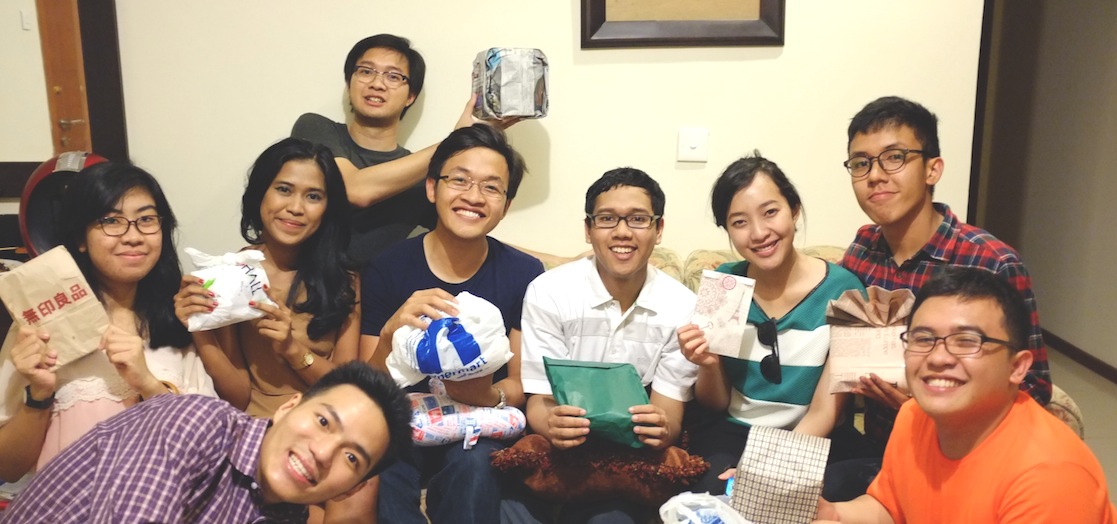
Another highlight of 2013 is that I had a great multitude of fun, a spontaneous, unplanned kind of fun. It involved doing a sudden Barbecue cook-out with some of my closest friends, midnight karaoke sessions, and most important of all: an all-around-the-United-States trip (whose tickets weren’t booked until 2 days before we took it)! I guess I simply had enough of being an uptight, downright-organized person, and apparently losing control over yourself is not a bad deal at all. Here’s to more taveling and real friendships in 2014!
7s. July

10. Tuman (Indonesian), v. “To find something enjoyable and want to have it again.”

You might wonder why (some people actually asked), someone who’d already been doing a lot of youth-related projects and should’ve moved on (read: yours truly), still bother to work on something completely dull and boring like Parlemen Muda Indonesia? Was it a post-power syndrome, or simply the fact that I had nothing better to do? Truth be told (and I’m not trying to cover this up whatsoever), I simply enjoy the entire organizational process: the planning, the crises, the coming to a solution, all the thrill that leading a project brings you—but mostly the planning. Will I do it again this year? Probably not, but not because I don’t enjoy doing it—I simply want to try focusing on something I should’ve been doing this whole time. Something like, you know, actually trying to write a book.
Riris

11. Piropo (Spanish), n. “A compliment paid on the street (which ranges from polite to raunchy).”

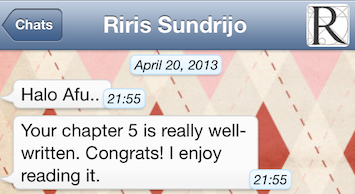
What I learned over 2013: one shall not pretend that he/she is lousy at something just to make people think they’re humble, because clearly humility doesn’t work that way. I believe that’s everyone should find the one thing they truly love and/or are good at, then stand up for it. I also trained myself not only to get used to compliments, but also making the effort to thank these people for their kind words while pushing down the urge to let the rest of the world know about it. (Except for this one, of course. A compliment from Mbak Riris—my awesome dosen pembimbing—even a petty one like this, is simply too overwhelming to be kept a secret. Pardonnez moi. HAHAHA.)

6. June

12. Vybafnout (Czech), v. “To surprise someone by saying ‘boo!’.”

And 2013 did that by letting me speak to Vladimir Putin, the very father of Russia. I did not know the possibility of this until I actually stepped onto St. Petersburg and heard the rumors about the opportunity for 20 Delegate Leaders to sit down and have an actual chit-chat with him. I guess the year was just messing up with my expectations and the whatnots. In a generous way. (If you speak Russian, you might also want to watch the video and jump to 1:06:06.)

H67Cqk6a

13. Mahj (Persian), adj. “Looking beautiful after a disease.”

One of the things I decided to confront this year is the insecurity over my not being pretty. When I said ‘pretty’ I did mean the capitalism-imposed version of it: one would quickly conclude that I won’t make it as any magazine’s cover. But this year somehow, just somehow, I had the people kind enough to repeatedly say over my ears that I am beautiful, at least when I was pale and sick :)) What’s actually better: to know that they still stick around despite you being unpretty. I somehow suspect that maybe we don’t really want to be perfect and admired—maybe we just want to be ugly and accepted.

***

Anyway. There are some words that I thought would mark 2013 but proven to be completely wrong: ‘torschlusspanik’, a German word for “the fear of diminishing opportunities as one gets older” and ‘parebos’, an Ancient Greek meaning “being past one’s prime” are two of them. But no, being 21 years old proved itself to be one of the best times of my life.

Andika told me that life is supposed to be full of surprises and that’s what you need to be prepared of. To have more of them. Some people try doing ‘yetu’, a Tulu-Indian word for “gambling in which a coin is tossed and a bet laid as to which side it will fall on“, but the wiser ones know that it’s a futile effort. You just have to take the roller-coaster ride and feel the breeze in your hair.

Now comes the part where I share what I really wish for 2014: to stay grounded and unpretentious. Basically to still find comfort in riding angkots-quo-Commuter Lines, as well as eating street foods (I’m sure Angkringan will forever be good). I won’t promise myself to write more, but I hope my upcoming 2014 journey would be meaningful enough to take notes about.

Oh and here goes a little quote that is totally unrelated but so beautiful I simply cannot resist to not use it to close this long post:

“Great conversations are like beautiful squares in foreign cities one finds at night and then doesn’t know how to get back to in daytime.” —Alain de Botton

Democracy: The Story of a Spoiled Child

“Don’t (write), unless being still would drive you to madness,” says Charles Bukowski.

Having been extensively exposed to our domestic politics lately—mostly through talks with Andika or works related to Parlemen Muda Indonesia—I couldn’t help but to spend a significant amount of time revisiting my idealism of how a government should work, and consequently grows a strong urge to write this very essay.

I’ll start with a big question mark: is democracy the best power system in the world? Seeing how a majority of countries today decided to embrace it, most people would probably find the inquiry not very challenging. Yes, they would say, a type of government whose power comes directly from the people being ruled must be the fairest deal available. Because really, who would want to be ruled by a blood-appointed individual (like in classic monarchy) or an elite group of privileged intellectuals (or what Aristotle called as oligarchy)? Well, let’s talk about that a little bit more.

Untitled
[Picture courtesy of House of Infographics and AyoVote, two awesome youth-driven initiatives.]

Let us first establish what we mean by ‘best’—I would propose the following: 1) rational with accountable rulings and decisions, 2) effective in ensuring wealth and prosperity of many, and 3) less prone to tendency to corrupt. From a historical point of view alone, one could argue that many empires, dynasties, as well as other similar non-democratic regimes have successfully achieved these three steps of being a ‘successful government’ although not entirely flawless. But so isn’t democracy.

At the end of the day, perhaps the main debate should sit at the principles where they were built upon; it is not a race of achievements, but more about the basic notion of justice and ensuring a playground that enables us to protect it.

So, what’s with the spoiled child, again? Well…

I. He Was Born Quite a Long While Ago (As a Different Breed)

In the city-state of Athens, around 507-508 B.C.E. It means that mankind has learned about it for almost 2.600 years and yet is still clueless about how to make it truly work. A good reason to this is likely the fact that what we know today as ‘democracy’ was not exactly what Cleisthenes referred to when he first introduced this back then. Despite having a similar property of executive-legislative-judicial branches like the now-democracy, the then-democracy had two largely contrast features:

  • Government administrative and judicial offices stood upon random selection of ordinary citizens
  • Legislative assembly consisted of all Athenian citizens

By ‘all’ I really mean every single citizen living in the big A. Although, do not forget that numbers also matter here. Athens had only 30.000 official citizens (women, slaves, foreigners, and youth under 20 excluded) who arguably had equal access to education and assets. This made it possible for them to practice democracy in its most primitive, naked meaning: power (thus decisions and regulations)
from the people, for the people.

Now that the statistics became unbearable (I’m not sure if we can find a room or field large enough as a legislative assmbly to hold up all 200 millions of Indonesians), however, we had to learn the concept of representation. We had to accept that a smaller group of people (560 is pretty small, even compared to how the Greek did it) speak for us in the parliament, hoping that they really know what we want.

On top of that unfortunate reality, the inevitably growing disparity of knowledge and/or wealth among millions of us also made democracy a tricky business: it enables men possessing more money or intelligence to claim for power by buying/manipulating votes from the poor and/or the stupid. I cannot agree more when Will McAvoy said that a well-informed society (and a prosperous one, an economist would add), is prerequisite to a healthy democracy.

II. His Friends Enjoyed Playing Different Kinds of Games

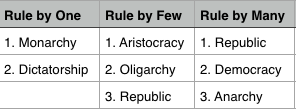
Newsflash: democracy is not the oldest form of government. It is mainly patriarchal monarchy, traced back to the days where the alpha-males led their tribal groups. The oldest sons usually had it coming that they will rule after their fathers ceased, and therefore had longer time to get himself prepared for the throne. In fact, based on the numbers of rulers alone, democracy has 7 good companies:

Screen Shot 2013-11-03 at 20.49.51

And by no means to surprise you, I’m actually a fan of oligarchy (rule by a group of best people—sometimes confused with ‘aristocracy’, never quite understand the difference between them)—albeit I would like to emphasize that meritocracy (whose tenet is basically ‘individuals with merit should hold power’) shall be the very core of it. A month ago Daniel A. Bell and Chenyang Li wrote an insightful essay about Compassionate Meritocracy which caught my utmost attention, defending Singapore’s political system (or what the West often labels as ‘pseudo-democracy’) which advocates ‘an institutionalization of mechanisms aimed at selecting the candidates who were best qualified to lead—even if doing so meant imposing constraints on the democratic process’.

It is exactly this that makes me reluctant to completely believe in democracy: people stop debating on the strategies to choose the best leaders because it hurts the universality of democracy. Since “democracy demands only that the people select their leaders, it is completely up to voters to judge candidates’ merits“. I mean despite forcing candidates to spend a big portion of wealth in producing banners, posters, and all kinds of expensive advertisements, democracy still does not guarantee that we get the best possible individual to lead or legislate for our country.

If anything, democracy is simply ineffective.

III. Many Good Rumours About Him, Though

Should these flaws stop us from sticking ourselves to democracy? I’d love to say otherwise but the answer is no. Yes, democracy is ineffective and there are many loopholes in it, but it also halts people from going to war (pure monarchy does induce possible hatred among royal family members and attempts of power acquisition from other houses—yes, by the way, I watch Game of Thrones). Additionally, democracy creates disincentives for governments to go to war with one another (since the people will ask them to stop). Democracy could’ve done a lot better had we fixed its derivatives.

I use the word ‘spoiled child’ to describe democracy because people have been taking it a little too much for granted. You can use it as a magic word in any kinds of legal plead or political speechpeople are likely to respect you if you respect democracy. Additionally, a ‘democratic process’ has an ameliorative sense by definition, but the truth is, today’s Indonesia is not the best home for our spoiled child to grow, and here are some quick facts for us to think about:

  • The statistics predict that from the total 55.000.000 of our below 30 voters, 50% of them are very likely to not give their vote to any party (golput).
  • We still have a high number of people living in property with low access to education and complete information about political candidates (both executive and legislative), disabling them to make the best possible decisions.

They say that there is an irreplaceable fun and great learning from making mistakes—well, I just hope that our fun and learning process is over. I hope that 2014 is a game-changing year for Indonesia’s democracy. I mean, at some point, the child has to grow up, doesn’t he?

Chicken (Ideas) Or Egg (Words): Which One Came First? (a.k.a. The Grand Debate of the Linguists)

Here’s an invitation to one of the most contested preposition in the study of language: whether or not human minds are capable of producing thoughts had there been no supporting vocabularies to express them. Say: 1) would our eyes be able to differentiate the color ‘turquoise’ from generic ‘blue’ had fashion given less crap about it? 2) would any adult be able to understand the number of chocolate in a box had English decided to delete numbers from dictionary? and 3) would these questions have even the slightest chance to pop in my head had my parents chosen to forbid me from learning language?

Pocket-Watch-l

A number of scholars confidently nods to that possibility. Steven Pinker, taking sides with Noam Chomsky in The Language Instinct, argues that yes, even without the words to describe so: 1) we would still have the biological capacity to strike a line in the color spectrum of green-blue for ‘turquoise’, 2) we would know if some of our sweets are missing, and 3) I would regardless be curious about how language shapes the way we think. They both believe that humans are born with the innate talent to communicate with one another, and that the Eskimos’ ambitious naming of ice only affirms that tribes will eventually come up with specific terminologies when there’s a necessity for it.

This has been a strong rebuttal to George Orwell, whose 1984 depicts the scary scenario where language becomes a means for extreme thought control. In that dystopian world, the Minitrue (Ministry of Truth) modifies English into a much simpler language called Newspeak, whereby the word ‘freedom’ as well as other value-giving adjectives have no rooms for existence. Orwell basically proposes the idea that inventing a language (or in this case destroying one) is a very (if not the most) effective way to disallow thoughts and take over people’s heads. He contends that, not having the word ‘independence’ will profoundly limit a nation’s cognitive ability to understand the concept from the first place, let alone to actually desire it.

So which one actually came first—chicken (ideas) or egg (words)?

Earlier this afternoon a friend tweeted me this article about how a Brazilian indigenous group of 700 people are anumerate for their language’s lack of words for numbers, confirming Orwell’s proposition. A couple of months earlier, however, I bumped into a New York Times post quoted otherwise:

If different languages influence our minds in different ways, this is not because of what our language allows us to think but rather because of what it habitually obliges us to think about.

Interpreting bahasa Indonesia into English, for example, will enforce you to be a lot more time-sensitive, while entering French requires you to be significantly more gender-sensitive. These aspects of language do not particularly permit or ban you from thinking in a certain way, they just push you to pay more attention to certain details.

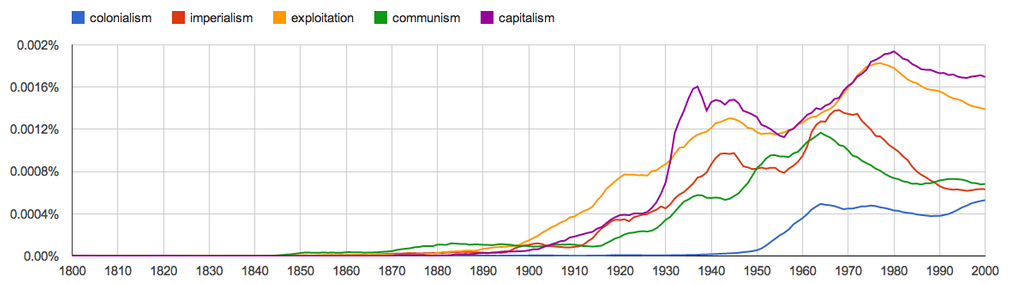
Just last week, the same friend introduced me to Ngram, Google’s not-so-new yet very fascinating webtool. Also dubbed as ‘the language time machine‘, this feature lets users identify the frequency of word usage over time, using Google’s storage of thousands of electronic books as a database.

Screen Shot 2013-10-10 at 10.21.50 AM

Quite interestingly, upon entering the words ‘colonialism’, ‘imperialism’, ‘exploitation’, ‘communism’, and ‘capitalism’, a similar rise-and-fall fashion can be observed (see graphic above). Looking retrospectively, of course, it is apparent that a link between history and such vocabula-trend does exist, although a deeper research must be taken before coming up with any conclusion at all. If anything: Ngram shows us that words are invented and consequently expire when a new, more suitable word replaces it.

Quite related to that: I have spent the last few months assisting a senior on a research about Indonesia’s foreign policy during Soekarno’s era using a discourse analysis approach. The analysis (partly out on The Establishment Post) includes an identification of keywords that we assess as the late president’s building blocs to establish Indonesia’s position as the leader of Third World countries, collecting countries’ favor to vote for us on the West Irian issue. It was an entirely different dimension in doing an International Relations research, and I am quite grateful to have been involved in it (yes, Yere, that’s my thank you note right there).

As usual, in addition to my being too coward to draw any conclusion, I believe you will have more fun figuring out the truth by yourself. So yeah, the chicken-or-egg rhetoric will sit there for a while. In case you haven’t been interested in language, think about how its affects are truly profound in shaping civilization (thus ideas traveling through time).

P.S. Apology to the fact that a classic clock makes no relations whatsoever to the topic being discussed; I just found the picture very pretty. Hope you had a great Sunday.

Love Is a Verb: Why We Write Letters About It (Not At All a Cheesy Post)

Breaking news: I’m a little afraid of getting stuck in the adulthood trap of being boring. Thankfully enough, I’m not yet there—I’m still greatly able to take pleasure from writing fictional love letter series on my other blog lately. One of them (To Philosophy, from Religion) actually embodies what I’ve been meaning about ‘presenting a non-fictional notion through fiction’ so if you happen to enjoy Conundrum of Paradox, that piece might as well amuse you. Although, as weird as ‘enjoying your own writing’ sounds, this one is my personal, self-written favorite.

8255495406_6fa4f27363_z

This post, by the way, will cover the rather unemotional fragments of love letters:

1. It Started with the Princes and Princesses

Interestingly: if we go back to visit the earliest generation of mankind, we would discover that the existence of affection toward another human being did not really involve a piece of paper (papyrus was only invented long after the first homo sapiens felt attracted to one another), let alone writing it down. No, ladies and gentlemen, love letters as a platform to express emotions were not popular until, what, late 12th century or something, when parchments and quills become one of the traded goods. The first individuals who put this into fashion were, I suspect, the royal people—mainly because someone from the lower class wouldn’t have possibly been able to afford it.

Quite reasonably, many of the most important phenomena in history were recorded by, if not triggered by, love letters. Long before youth started romantic conversations through trivial text messages while finding slots to flatter and finally ask their counterparts out, our Sultans and Putris and Gubermens sent letters—beautiful, lengthy letters—to write which they needed to actually sit down and take a couple of hours before sending them in a sealed envelope. Slipped between these handwritten, fondly sentences, were plausibly information on their kingdom’s latest development and the economy of their people. I recall there was a book about it—Love Letters of Great Men or something?

Today, unfortunately, we bother not spending more than 10 minutes to compose a text-formed message—we are used to limiting our elaborative capacity to short emails, less-than-140-characters tweets, or even less through real-time chat services.

One of the main reasons why I think I belong to the 20th century is my ridiculous enjoyment of writing long (and by ‘long’ I really mean ‘long’) emails—possibly a consolation price to my not being able to write long letters on real parchment pages.

2. It Engenders an Entirely New Writing Persona

Remember one of my old posts assessing Goenawan Muhamad’s theorem of a spectrum of author’s personae, triggered by different forms of writing? He mainly argues that an open article for the public captures a different personality from what a personal journal or a private letter does.

To reiterate how they are different from one another:

  • Writing a public article is like singing out loud up on a stage in your own concert—you are very self-conscious about how people would judge you, etc.
  • Writing a personal journal is like entering a private capsule rocketed to the space—absolute nonsense might appear and people don’t have to be able to relate to it.
  • Writing a letter, on the other hand, stands somewhere in between these extreme ends: you know who’s going to read your letter (usually a good friend except when you’re trying to introduce yourself to a stranger), thus your words and perspectives are tailored in a certain, self-conscious way, but it also has a loose filter system.

That’s what I admire the most about letters—especially love letters: they invite a brand new writing persona that wouldn’t have been known at all otherwise. On top of that, it is far more exciting to swim into the happy thoughts of people in love than reading the story from an outsider audience, 3rd person point of view, or simply knowing exactly what’s going on inside their head from a
1st person’s perspective.

Instead, being a reader of letters means putting yourself on the shoes of the actual addressee,
having fun assuming these letters were written for us, or visualizing how the writer and receiver correspondence with each other in the real world.

Because who does not love reading Darcy’s letters to Lizzy, really?

3. The Best Are the Most Honest Ones

Do you have to be in love to write good love letters? Yes and no.

Trained writers, who develop an instinct to see the beautiful side of almost everything, tend to find it easy to fall in love. Whether or not the feeling is real, is another matter (a very tricky one to prove, too), but such perspective is enough to produce nice, heartwarming love letters regardless.

Writers with shorter airtime might possess a narrower storage of vocabulary thus find it hard to make an enjoyable, descriptive letters—but this does not make their feelings any less beautiful. In the end of the day, I think the best love letters are the most honest ones—it being short or long, grammatical or not, does not really matter.

4. Everyone Has a Secret Yearn to Write One

Sometime during the Lebaran holiday, I impromptu-ly came up with this Love Letter Series holiday project. It started with Fadlan Mauli’s deliberate act of posting a love letter with a similar tone to my earlier series—and I thought, “Wouldn’t life be a little nicer if more people write love letters—to strangers they meet on a train or friends believing in different gods?”

I believe that people need to know—no, they need to understand and answer their natural call of expressing affection through words. They need to dwell in the hardship of finding the adjective to describe how the person sitting next to them means so much, that it is okay to let them know how they make us  feel or become. That it is relieving to expose that tiny vulnerable part of us that is inevitably there.

Surprisingly, the project received a very warm welcome with over 60 submitted letters and 19.000 views throughout August. This just makes the case even stronger: that each of us has that undeniable emotional spark inside, no matter how hard we try to ignore it. I am so happy to have, among others, Ryan Adriandhy, and many other unexpected names (who wouldn’t otherwise be writing love letters) also participating in this project. Browse through those awesome love letters here.

I may or may not have to give some credits to Sarah Kay’s spoken words series (watch one From Toothbrush to the Bicycle Tire—one of her greatest pieces), as well as Aan Mansyur’s proyek surat cinta (which I just learned recently). Both of which are awesome.

5. Because Feelings Are Like Words

Feelings are like words: just because you don’t know about them does not mean they do not exist—sometimes even in your own language. I’d like to think that writing love letters is like looking them up in dictionaries, exploring the undiscovered pages, and realize that you might have been wrong about how you (think you) feel all this time.

P.S. I’ve been enjoying the editing process of Love Letter Series holiday project so much I find it hard to decide if I enjoy being a writer more than being an editor.

P.S.S. In case you haven’t: write one, it’s deliberating.

P.S.S.S. Pramoedya Ananta Toer’s Buru Tetralogy and Ayu Utami’s Bilangan Fu are two over-the-top examples of how fiction can be very, very powerful in sending thought-stimuli. (Not that you did not know about this.)

What They Don’t Talk About When They Talk About Graduating

The past month had been quite of a roller-coaster ride to me—which probably makes the most acceptable excuse to why I hadn’t been blogging lately. You see: people don’t really write on a moving roller coaster; they either find a grip, close their eyes, both, or give up and simply cry in half-excitement. In other words: trying to survive the ride. That’s pretty much what I’ve been trying to do: enjoying the unexpected happenstances—they might be inconvenient sometimes, but most of the time, they are also fun.

To make it short: 1) my study period in Singapore finally came to an end, 2) I completed all 117-page of my thesis, stood up for it against all criticism in the defense room, and passed the exam (!), 3) a think-tank whose philosophy lies in being the ‘intersection of environment and socio-economic development‘ hired me—a perfect first post so far, and consequently 4) Jakarta had to welcome me as one of its new residents.

All of these happened in less than 10 days, left me overwhelmed with all the sudden changes, and took me a while until I could look back in retrospect and say what I have to say here.

box-girl-letters-mail-photography-Favim.com-358866

1. Education Is a Means to a Means…to an Endless Chain of Means

After four years of reading hundreds of journals and writing dozens of papers, of course, a celebration is in order. It is totally comprehensible to feel like you’ve passed a certain finish line after a long marathon called ‘undergraduate degree championship’. However, just like successful democracy is worth-celebrating but does not guarantee a prosperous society, so is your degree. By no means to be a party pooper, the moment you hurriedly walk (with your annoying heels) to the stage and receive your bachelor certificate marks no transition point to a new life phase whatsoever. The truth is, graduating is merely a process of a process of a process…which probably yields to an infinite number of processes. But it’s undeniably an awesome pause before you have to continue moving in a fast-forwarded track, for what it’s worth.

2. You’ll Go Back to the Bottom of the Pyramid

Commencement speeches can only encourage us into somehow believing in ourselves and taking opportunities. But beyond that, there is a more urgent news that people usually sweep under the rug: you’ll re-experience a familiar meritocratic-climbing process you once underwent in the college. I’m not saying that it sucks; on the contrary, I see it as a stimulating and enriching challenge after feeling stuck at campus-based organizations. You get to learn to be a subordinate again (with a hopefully nice supervisor), to follow instructions (instead of giving them to your juniors), to get confused and ask a lot of stupid questions (being a senior could be tiring because we’re supposed to know everything). It’s a humbling experience, and you’ll definitely learn something out of it.

3. The Word ‘Depression’ Now Comes with Flowers

I am not talking about deadlines—compared to this one, deadlines are toothless: wedding invitations! Someone you know from high school suddenly sends a pink envelope stamped with calligraphed ‘D & D’ to your office desk, emails with “THIS WEEKEND: YOU’RE INVITED” subject floods your inbox, or direct invitation through phone calls that are supposed to make you feel special but inevitably depressed. If not now, you’ll meet them soon—probably in 3-5 years. What I would love about my friends getting married, though, is the fact that I will have cute nieces and nephews :))

4. You’ll Get Distracted from Work

Some people would expect that, after graduation, they can cut themselves off secondary businesses and focus on developing a career. But no matter how hard you try, you’ll get distracted—for a lot of possible reasons. Childhood dreams (to write a book, to change the world into a better place), seemingly-irrelevant hobbies (building ship miniatures), other opportunities (part-time research assistant), or, you know, crushes (with someone you’re supposed to build a professional relationship with). From my very limited observation, though, these distractions actually worth time-investing more than the actual work deal. The truth is, regularity kills—not only physically because you spend a lot of energy to excel amongst your peers, but also emotionally when you don’t keep your mind producing new ideas and aspirations. So, my take: be distracted.

5. You’re Someone Else’s ‘Other Half’ Now

There is a huge difference between volunteering in an organization as a student and being a full-time employee who gets paid every month. The latter means that you are to spend 40 hours a week acting and thinking on behalf of your company’s interest. You will start introducing yourself as part of this larger industry, and be self-conscious about representing them in your speeches and daily conduct. In other words: almost half of your identity now links to who/what cause you work for. Hence, just like getting married: choose your ‘other half’ very, very wisely.

6. Your First Job Should Not Be Your Last One

Because, ladies and gentlemen, you’ll never know what you’re missing unless you try all of the options you have. It might be the most wanted job in the world, but I believe that life is more than just about settling down to ‘perfect’. Instead, us humans are equipped with the ability to go through our worst days and cherish the best ones. Fear not: listen to yourself and take your chances. Sooner or later, you will be thankful even for having chosen the ‘wrong path’—although the phrase itself does not make sense—all paths are meant to lead you somewhere. It’s just a matter of time until you see it.

P.S. You might want to close your perfect Sunday by reading An Ideal Coffee Shop Conversation. Good night.