Adjectives and Comparisons

Of all eight parts of speech that Mr Nurhadi taught me back at highschool (verb, noun, pronoun, adjective, adverb, preposition, conjunction, and interjection), I’ve always hated adjectives. The reason behind such animosity is mostly the fact that the mere function they offer is to compare.

You’re only beautiful since there are ugly people at other parts of the city. You’re perceived fat because there are skinny people around. The word tall would never even emerge if there aren’t height differences between people.

Chicago-towers-comparison-high_res

“Not tall enough, architects. Build some more!”

No matter what adjective you put in a sentence, add ‘not’ and voila! There, you got the exact adverse word. Even the word neutral distinguish you from the not neutral (either rightist or leftist) people. Shall you find any adjective that doesn’t go with its opposite, I might finally die in peace.

The lesson learned tonight is, whatever label people put on your head, fashion, or friendship, you should not waste your precious time on minding about it. They might use any adjectives to either compliment or bring you down, yet you know exactly that you’re the only person who knows what you’re worth.

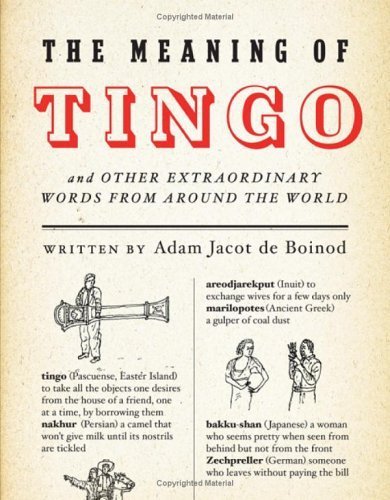
How Can I Not Know About This Book?

9781594200861

The Meaning of Tingo and Other Extraordinary Words
from Around The World.

Major want. Please let me know once you’ve found this book in Indonesia.
Or any other parts of the globe. Let’s take a peek:

  • Vokabulyu: Russian–“passion for foreign words”.
  • Nglayap: Indonesian–“wander far from home with no particular purpose”.
  • Karoshi: Japanese–“death from overwork”.
  • Fissilig: German–“flustered to the point of incompetence”.
  • Samlermani: Danis–“mania for collecting”.
  • Neko-neko: Indonesian–“one who has a creative idea which only makes things worse”.
  • Ataoso: Central American Spanish–“one who sees problems with everything”.
  • Zechpreller: Cerman–“someone who leaves without paying the bill”.
  • Tsujigiri: Japanese–“to try out a new sword on a passer-by”.
  • Mariolopotes: Ancient Greek–“a gulper of coaldust”.
  • Areodjarekput: Inuit–“to exchange wives for a few days only”.
  • Nakhur: Persian–a camel that won’t give milk until her nostrils have been tickled”.

Adam Jacot de Boinod needs to find a word which describes ‘a person who is very passionate about foreign grammarical rules’. *mind-blown*

Do You Speak Russian In Your Dreams?

Unless you master the language in real life, I don’t think so.

One day before the Konusma Yarismasi (a random language competition I attended in Istanbul), my Turkish teacher joked by saying: “If you really want to win tomorrow, make sure you dream in Turkish tonight.” At that time, stupid and naive, the young me laughed and didn’t take it seriously.

Sdf

After some time, I stumbled upon articles which exposed researches done by smart psychologists and discovered that there really is a certain relation between language aptitude and your subconscious realm.

“Dreams present themselves as more than just a series of images. A dream need not to be a ‘silent movie’ or silent videotape; it may also include a ‘sound track’. While this sound track may contain all sorts of auditory impressions, it usually abounds in verbal material.” Linguistic Aspects of Freud’s Dream Model

Evidences showed that apparently the language system is also active during your unconscious phase. Thus, you might actually refer to your dreams in checking whether you’ve achieved certain level of proficiency in a new language. Oh! Probably one day TOEFL and IELTS would require ‘dream-testing’ added to your final score!

Hence, should my mind have absorbed Turkish vocabularies and grammar rules well during the past month of trainings, it would easily be able to set Turkish as my ‘soundtrack’ that night. What happened back then? I did dream about having a chit-chat in Turkish. So, yeah!

Good luck paying more attention to the language you use when you dream.

Which Language Do You Pray With?

I am carried away realizing the fact that billions of people in this planet are establishing their private connections to God from different cities in different continents, through prayers via at least a thousand different languages. How each and every single one of them has the exact same concept of God as omnipotent, omniscient, omnipresent, and omniunderstanding although they learn through different words and sentences is simply astonishing.

Language_books

Now an intriguing question comes knocking my unresting mind: Does the language you use to pray with affect the way you perceive God? Or, the way you comprehend the idea of ‘praying’ itself?

Some languages facilitate its users to communicate better narratively, some others are more romantic, mnemonic, sermonic, or plain blunt. There are values attached to each language, histories behind words, and stories behind expressions.

For instance, American English has less complicated combination of words and is relatively more straightforward. Whilst Turkish possesses extra rooms for amorous metaphors and bahasa Jawa helps you to feel much less-powerful than the Kings.

When I was a kid, I used to pray in bahasa Indonesia, in which I see God as a close-yet-unreachable respected Figure. I bet you’re very familiar with this:

Ya Allah, mudahkanlah hamba dalam melaksanakan ujian besok, semoga hamba dapat mengerjakannya dengan tenang, berikan hamba kecermatan dan kekuatan untuk menyelesaikannya sebaik mungkin. Hanya Engkau yang dapat menolong hambamu.

Now, when I try to call Him, I talk English. He’s become a dear and close Friend that understands me better than anyone else, that has power to solve my every problem, that causes things to happen. The word ‘hamba‘ and ‘Engkau‘ which have significantly different meanings with the normal ‘saya‘ and ‘kamu‘ (don’t forget that we still have ‘aku‘, ‘kau‘, and many others) do not exist in English. In English there’s only one ‘I’ and ‘you’, which are useable for both parents and peers, boss and colleagues. This, to some extent, blurs the separating distance (in a positive way) that bahasa Indonesia puts between you and your God.

In this context, back then I prayed only when I need to ask for things, because ‘problems’ once meant ‘not-being-able-to-watch-Sailor-Moon-due-to-electricity-cut-off’. However, today, the word ‘problems’ grows as ‘complicated-situation-between-me-and-campus-matters’. Thus, I pray not only to make humble requests, but also to tell stories, to let go burdens, and to feel peaceful. In both ways, the practice of praying itself will always be a sacred ritual that calms and sooths my agitated heart.

Do you experience the same shift of language-use in your prayers?

New Language, New Self?

Me: “Hey William. To continue the discourse on Twitter.. It’s like, to the extreme part, languages reflects different ‘selves’. Misalnya imej lo ketika pake bahasa sama pake English jadinya beda.”

Will: “TRUE. A different persona indeed. But is this more to the written or oral side? Or both? In oral  the proficiency of the language also affects the persona you put on with that language. Actually the same goes with written, but oral shows the persona more clearly.”

Me: “In my theory, proficiency of the language is a prerequisite to actually have that ‘new self’. And yes it covers both written and oral form. So once you really master a language, you’ve created a new self.”

Will: “But another observation I made. Yes that’s true because the thinking process in every language is different as you stated. But in my case I am fluent in both bahasa and English. Jadi saya bisa menggunakan ‘self’ English saya dalam Bahasa. Dan sebaliknya. Seakan dua persona ini berasimilasi.”

Me: “No no no. The approach you’re using is a persona-centered. My approach is more language-centered.”

Will: “And the difference between them?”

Me: “…In which I’ve stated that ‘each and every language is linked to a certain history and paradigm’. Words that you have in English aren’t commensurable in Indonesian. Thus, the self you reveal in English can’t be fully ‘revealed’ in other languages. So…languages are like different windows in a house. You can only see certain parts/rooms from one window and other parts from other windows. I hope you get what I mean…”

Will: “I agree. But that is theory.”

Me: “That is.”

Will: “Sorry I meant that theory has more intricate factors behind it.”

Me: “That’s true. ‘Intricate factors’. Apa itu istilah di ekonomi…ceteris paribus ya. Teori berlaku ketika faktor lain dianggap sama.”

Will: “In a way I can’t really put up an argument since I agree with you. You can speak other languages such too right besides English and Indo. I have an okay proficiency in Japanese and Mandarin; and yes the language can’t be fully revealed in another language. So I fully agree and can’t really put up a fight but I’ll try.”

Me: “You don’t have to, you know. Better save the energy for whatever you’re doing in campus today -.-“

Will: “Lol I actuallly have work. So it’s a wrap then.”

Me: “Err okay.”

Will: “It’s just that from a personal experience I know that there is a different ‘self’. What that self is and the difference between the two I only have an outline of it, but I can’t fully comprehend what it is.”

Me: “I feel like Keohane being criticized by Cynthia Weber.”

Will: “Lol what is that?”

Me: “IR scholars who really like to rebut each other even when they aren’t really opposing the other’s argument.”

Will: “Anyway yes so there’s self A and B for example. It’s just the nature. Since I have mastered both languages I can consciously swap them both. I have a clear outline on what both of these selves are but it comes real close. And there is a default self that shows when you use either language.”

Me: “True.”

Will: “It wouldn’t be quite the same when using Indo with the English self. This requires an very fine understanding of your inner capabilities in both languages.”

Me: “See? You’re using a person-standpoint. Just like what you say, thinking process takes different ways in different languages. You can’t really distinguish the ‘self’ when you’re inside the ‘house’. But for language observers you’ve become a (probably not totally but) different person.”

Will: “That’s why I said from a personal experience. I fully agree with what you’re saying though.”

Me: “Now expressions, sentences, and metaphors are different in each language.”

Will: “Metaphors are true to each language and might not work in the other. Although not to the precise bulls-eye if translated, that lack of 100% is substituted to a 75-95% accuracy.”

Me: “Now that’s the thing. ‘Not to the precise bulls-eye if translated’. The way your environment perceives you will change as the language you use changes. I’m not rebutting at all. It’s just…you might see the same things from different windows; but with different angle, the…’understanding’ might be 95% similar yet your point of view will differ.”

Floor-and-windows_1332_19473791_0_0_7011429_300

(with more windows, more light can come in, and easier for you to show what’s inside–only if you aim to)

Will: “Yep true. Yes. To add on that the cultural differences also affect the understanding.”

Me: “True! Cultural differences contribute to a certain language’s frame of reference.”

Will: “And a more intricate detail? In oral the tone used also affects a lot. And probably more than what the words really mean.”

Me: “Haven’t really observed that. But come to think of it, true. Are we done with the Keohane-Cynthia rebuttals now? Have a good day!”

Will: “Haha it’s good to share thoughts and experiences. But anyway yeah have a good day. I’m late for work nooooooo.”

Me: “Hahaha good luck with that.”