Adjectives and Comparisons

Of all eight parts of speech that Mr Nurhadi taught me back at highschool (verb, noun, pronoun, adjective, adverb, preposition, conjunction, and interjection), I’ve always hated adjectives. The reason behind such animosity is mostly the fact that the mere function they offer is to compare.

You’re only beautiful since there are ugly people at other parts of the city. You’re perceived fat because there are skinny people around. The word tall would never even emerge if there aren’t height differences between people.

Chicago-towers-comparison-high_res

“Not tall enough, architects. Build some more!”

No matter what adjective you put in a sentence, add ‘not’ and voila! There, you got the exact adverse word. Even the word neutral distinguish you from the not neutral (either rightist or leftist) people. Shall you find any adjective that doesn’t go with its opposite, I might finally die in peace.

The lesson learned tonight is, whatever label people put on your head, fashion, or friendship, you should not waste your precious time on minding about it. They might use any adjectives to either compliment or bring you down, yet you know exactly that you’re the only person who knows what you’re worth.

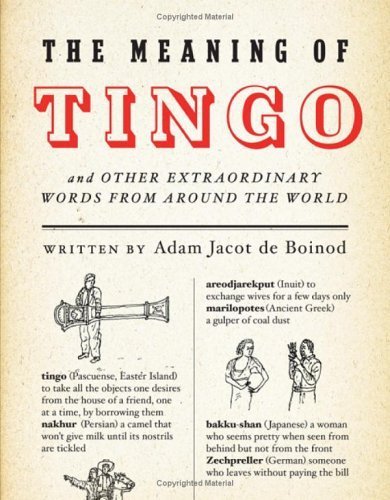
How Can I Not Know About This Book?

9781594200861

The Meaning of Tingo and Other Extraordinary Words
from Around The World.

Major want. Please let me know once you’ve found this book in Indonesia.
Or any other parts of the globe. Let’s take a peek:

  • Vokabulyu: Russian–“passion for foreign words”.
  • Nglayap: Indonesian–“wander far from home with no particular purpose”.
  • Karoshi: Japanese–“death from overwork”.
  • Fissilig: German–“flustered to the point of incompetence”.
  • Samlermani: Danis–“mania for collecting”.
  • Neko-neko: Indonesian–“one who has a creative idea which only makes things worse”.
  • Ataoso: Central American Spanish–“one who sees problems with everything”.
  • Zechpreller: Cerman–“someone who leaves without paying the bill”.
  • Tsujigiri: Japanese–“to try out a new sword on a passer-by”.
  • Mariolopotes: Ancient Greek–“a gulper of coaldust”.
  • Areodjarekput: Inuit–“to exchange wives for a few days only”.
  • Nakhur: Persian–a camel that won’t give milk until her nostrils have been tickled”.

Adam Jacot de Boinod needs to find a word which describes ‘a person who is very passionate about foreign grammarical rules’. *mind-blown*

Do You Speak Russian In Your Dreams?

Unless you master the language in real life, I don’t think so.

One day before the Konusma Yarismasi (a random language competition I attended in Istanbul), my Turkish teacher joked by saying: “If you really want to win tomorrow, make sure you dream in Turkish tonight.” At that time, stupid and naive, the young me laughed and didn’t take it seriously.

Sdf

After some time, I stumbled upon articles which exposed researches done by smart psychologists and discovered that there really is a certain relation between language aptitude and your subconscious realm.

“Dreams present themselves as more than just a series of images. A dream need not to be a ‘silent movie’ or silent videotape; it may also include a ‘sound track’. While this sound track may contain all sorts of auditory impressions, it usually abounds in verbal material.” Linguistic Aspects of Freud’s Dream Model

Evidences showed that apparently the language system is also active during your unconscious phase. Thus, you might actually refer to your dreams in checking whether you’ve achieved certain level of proficiency in a new language. Oh! Probably one day TOEFL and IELTS would require ‘dream-testing’ added to your final score!

Hence, should my mind have absorbed Turkish vocabularies and grammar rules well during the past month of trainings, it would easily be able to set Turkish as my ‘soundtrack’ that night. What happened back then? I did dream about having a chit-chat in Turkish. So, yeah!

Good luck paying more attention to the language you use when you dream.

Which Language Do You Pray With?

I am carried away realizing the fact that billions of people in this planet are establishing their private connections to God from different cities in different continents, through prayers via at least a thousand different languages. How each and every single one of them has the exact same concept of God as omnipotent, omniscient, omnipresent, and omniunderstanding although they learn through different words and sentences is simply astonishing.

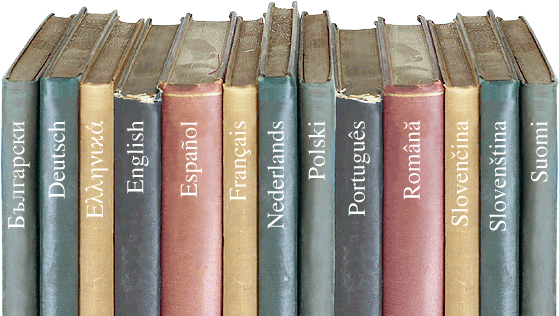
Language_books

Now an intriguing question comes knocking my unresting mind: Does the language you use to pray with affect the way you perceive God? Or, the way you comprehend the idea of ‘praying’ itself?

Some languages facilitate its users to communicate better narratively, some others are more romantic, mnemonic, sermonic, or plain blunt. There are values attached to each language, histories behind words, and stories behind expressions.

For instance, American English has less complicated combination of words and is relatively more straightforward. Whilst Turkish possesses extra rooms for amorous metaphors and bahasa Jawa helps you to feel much less-powerful than the Kings.

When I was a kid, I used to pray in bahasa Indonesia, in which I see God as a close-yet-unreachable respected Figure. I bet you’re very familiar with this:

Ya Allah, mudahkanlah hamba dalam melaksanakan ujian besok, semoga hamba dapat mengerjakannya dengan tenang, berikan hamba kecermatan dan kekuatan untuk menyelesaikannya sebaik mungkin. Hanya Engkau yang dapat menolong hambamu.

Now, when I try to call Him, I talk English. He’s become a dear and close Friend that understands me better than anyone else, that has power to solve my every problem, that causes things to happen. The word ‘hamba‘ and ‘Engkau‘ which have significantly different meanings with the normal ‘saya‘ and ‘kamu‘ (don’t forget that we still have ‘aku‘, ‘kau‘, and many others) do not exist in English. In English there’s only one ‘I’ and ‘you’, which are useable for both parents and peers, boss and colleagues. This, to some extent, blurs the separating distance (in a positive way) that bahasa Indonesia puts between you and your God.

In this context, back then I prayed only when I need to ask for things, because ‘problems’ once meant ‘not-being-able-to-watch-Sailor-Moon-due-to-electricity-cut-off’. However, today, the word ‘problems’ grows as ‘complicated-situation-between-me-and-campus-matters’. Thus, I pray not only to make humble requests, but also to tell stories, to let go burdens, and to feel peaceful. In both ways, the practice of praying itself will always be a sacred ritual that calms and sooths my agitated heart.

Do you experience the same shift of language-use in your prayers?

The Case for Religions

I bet many of you have been astounded by Karen Armstrong’s work on The Case for God (well if you haven’t previously, you’re about to). Read these two paragraphs:

We regularly ask God to bless our nation, save our queen, cure our sickness, or give us a fine day for the picnic. We remind God that He has created the world and that we are miserable sinners, as though this may have slipped His mind. Politicians quote God to justify their policies, teachers use him to keep order in the classroom, and terrorists commit atrocities in his name. We beg God to support “our” side in an election or a war, even though our opponents are, presumably, also God’s children and the object of his love and care.

Religion is a practical discipline that teaches us to discover new capacities of mind and heart. …Like any skill, religion requires perseverance, hard work, and discipline. Some people will be better at it than others, some appallingly inept, and some will miss the point entirely. But those who do not apply themselves will get nowhere at all. Religious people find it hard to explain how their rituals and practices work, just as a skater may not be fully conscious of the physical laws that enable her to glide over the ice on a thin blade.

A subtle, delicate way to define God and religion, two magic words that people utilize (underrate, I should say) in almost everything they do. Bearing in mind that Karen’s an (more than) expert in comparative religion study, the fact that she uses common examples that are so close to us is simply mindblowing. Both concepts are huge and saturated, hence people would usually opt their unique way to explain it to others. Karen Armstrong, she…fluently, flawlessly, define them in such flowing sentences.

Related to that, this Thursday evening I had a date with three single ladies, going out to the movies and watched Gnomeo and Juliet. If you thought that we’re going to have some pathetic talk on love in the sleepover afterwards, you’re utterly wrong. With all credits going to Dwinta Kuntaladara (and a Rama-Sitta painting on my wall that stimulated the whole thing), we had an IR-ish discussion on religions, and an epiphany came across my head. Said her:

Jadi Fu, aku punya pikiran kayak gini: Imagine God being the center of gravity–bukan Clausewitz, bukan (strategis perang, red). Just, the center of everything. And then there is you, standing at its North, me at its South, terus Ipeh…you’re at the East, dan Candini di Barat. Every single one of us tries to get ourself closer to God. How? Afu, since you’re here (pointing on ‘N’), you move southward. I, I move northward. Ipeh akan bergerak ke Barat, dan Candini bergerak ke Timur. Arah-arah itu adalah apa yang agama kita masing-masing suruh kita untuk lakukan. In the end, we’re reaching the same destination.

The clash happens when you see me going to the opposite direction of where you’re traveling to. Some people would tell, “Hey, kamu jalan ke arah yang salah. Jalan menuju Tuhan itu ke Utara!” Padahal, dari posisi kamu Fu, South is where you should go to.

My reaction was, as most of you probably are, stunned. “I love the idea, Dwinta. I. Totally. Do.” I love the idea that God is a destination and religion is a map to get there. It’s simply impossible that everyone’s going towards the same direction because God made you born with different initial positions, different stories. MAN, THAT PERSPECTIVE CAN ACTUALLY PUT THIS WHOLE WORLD IN PEACE! I’m saying this with goosebumps all over me.

Many people are busy sharing their ‘map’ with others, debating on which publisher created the best map, and overlooked the obligation to actually describe what you’ll find in the end of the road. God, the divine being, in form of Allah, Yahweh, avatars, or whatever other different names humans label Him with.

In addition to that, I’m a true believer that language and semantics bear some of the guilt of mankind’s misunderstandings towards each others’ religion. The fact that the oldest Bible was written in Hebrew and got translated to almost every language in the world leaves a part of me questioning on its purest meanings. Same assumption applies to Islam’s Qoran, Buddha, and Hindi’s handsome scripts.

Abrahamic religions densify God into one single image to Whom their believers can cling on, ask for, and be weak to. Dharmic and Taoic religions, however, believe that God is a grand construction that is all-encompassing, present wherever humanity is present. After all, we’re looking for the same light. After all, we believe that there is something else, something big, beyond what is physically seen.