Les Beaux* Portmanteaux

A couple of days ago, I was tickled by Jack’s conception of ‘language sandwich’ in Emma Donoghue’s Room where he made up two-fold words like ‘hugermous’ (from huge and enormous). Just a night before, I tweeted something about ‘extrhausted’ (from extra and exhausted) to give more weight on the worn-out state. Later, Nico Novito enlightened me by popping-up with the correct label for such self-made products and it’s called ‘portmanteau’!
(Originally a French word, we could guess?)

A portmanteau, as elucidated on Wikipedia, is a blend of two (or more) words or morphemes into one new word–usually both sounds and meanings. Take smog, for instance, was coined by collaborating smoke and fog. Funny thing, ‘portmanteau’ is also a portmanteau, derived from the word port(e) in French (means ‘door’) and ‘manteau’ (means jacket)!
(Surprising how semantics can always surprise you, eh?)

Snowpeaktitaniumspork

“Hey, Mom, I can’t eat my breakfast without the spork!”
(Spoon and fork, that is correct.)

The following examples are probably familiar to our ears (although a bit rarer to our eyes):

  • Blaccent: black and accent (when a non-black tries to sound black)
  • Bootylicious: booty and delicious (who doesn’t know this Destiny’s Child song?)
  • Bromance: bro(ther) and romance
  • Brunch: breakfast and lunch (the regular two-in-one meal for mahasiswa)
  • Camcorder: camera and recorder (a very helpful appliance)
  • Cocacolonization: Coca-Cola and colonization (a phenomenon that is also learned as an issue of international relations)
  • Cyborg: cybernetic (whatever that means) and organism
  • Linguogasm: lingua and orgasm (the sensation that comes up when you’re awed because of the hidden maze inside languages!)
  • Frenemy: friend and enemy (SBY might want to borrow this one in explaining our foreign policy, don’t you think?)
  • Mathlete: math and athlete (two subjects that would make a guy experting in both as some sort of god for the ladies)
  • Newscast: news and broadcast

How did you guys find it? Interesting? I believe that in the world of language, another word for ‘art’ is ‘portmanteau’. It may also be referred as the art of ‘creating’ with language. (Bear in mind that it’s ‘with’ language and not exactly the ‘language‘ because unless you’re the government in charge of a newborn nation like Soekarno or Ataturk, you can never ‘create’ language.) Good night!

*Credits to Adisty for the correction and interesting facts 

The Color of Language

Alright, this post is totally going to be freakish and preposterous.
Kindly bear with it.

Imagine ‘language’ as a concrete, vivid being. What would it be like? Is it transparent? What color does it come with? If defined in French, would it be a male noun or a female one?

The language (or languages, since we actually have more than one) I’ve claimed as my best friend for years has always been in a form of remarkably clever young lady that kindly spares hours on my working desk during semester breaks. ‘She’ surprises you every now and then with unexplainable dimensions of grammar rules, metaphors, and oxymorons.

Another form of language that is awkwardly engraved in my mind would be a box of riddles. This box is, somehow, blue. See, language is obviously not a humble being. Instead, it is a conceited creature that doesn’t care if you don’t understand what it tries to convey. Thenceforth, I imagine that the box would always be self-centric in the manifestation.

Imagetiffany021410

Blue is, whether or not you realize it, the color that is mostly used in language metaphors. ‘Out of blue moon’, ‘I’m feeling blue’, or ‘darah biru‘ (‘blue blood’, a metaphor for royal offsprings) are just a number of examples. There are probably more, not just in English but also in other exotic languages on the land of Arab and Africa.

Err–the point of this post would be, that if language had a color, it shall be blue.

Probably I shouldn’t have posted this. And you shouldn’t have read this.
This post is just some random bull crap in a Monday morning.

Stairs (Not to Heaven)

M. Iman Usman, on a night chat at a Starbucks table:

“Ini analogi gue ya, Fu. Orang yang ‘nyoba’ berbagai bidang itu memperluas tangga mereka ke samping, makin lama makin lebar, tapi sama sekali nggak membantu mereka untuk naik tingkat dan mendekat ke tujuan sebenarnya.”

(This is my analogy, Fu. People who try as many opportunities as possible in different fields are actually widening their stairs, but in the end they don’t have time to go to the next level and get closer to their desired destination.)

White_fir_entry

Lucky people are those who know where to go and take one step at a time.

How many of you, of us, really focus on a single thing at a time?

I know a number of people who are engaged in at least 10 committees and organizations at a time. Most of them, just as I also was, can’t be fully committed in any of these works since they should have their mind divided fairly. Multitasking is a talent that God bestows upon some of us, but come to think of it, great men (or women) who really excel and make history are ones who have their thoughts focused and set on what their passion is.

Say, you want to make your country a better place. You can do so by participating in either Indonesian Future Leaders, Garuda Youth Community, Ashoka Young Changemaker, LEO Young Club, etc. (with an emphasize on ‘either’–not more than one–because unless you do so, you won’t really contribute anything to these great organizations)

Say, you want to  have your writings read and your voice heard. Apply to journalistic club or radio station in your university, try internships at established TV station or newspaper offices. Get your books published! (DISCLAIMER: blogging is never enough)

Say, you want to make great research and astonish people with your unusual findings. Then you have to join research associations like Kelompok Studi Mahasiswa Eka Prasetya, or follow your favorite lecturer as their research assistant. I swear you can’t make a ‘boom’ without spending at least 6 months on your research.

See, options are there to pick, not to be greedily taken without any considerations. Indonesia needs more young minds that know what they want to do, not ones that agree with what people tell them to.

Ready to narrow down the width of your stairs and build it up instead?

Wkwkwk Or 555?

(With courtesy of Guinandra L. Jatikusumo)

Laughing used to be an active verb that requires you to lively–sometimes overratingly–shout ‘Hahaha!’ with your head moving back and forth according to your unique rythm. Yet once these genius came up with live chat programmes, i.e. Yahoo! Messenger, Google Talk, Skype, as well as other similar appliances, you have to laugh virtually. Now we can actually laugh without really laughing.

There comes the problem: how should we laugh in texts?

Let’s stop there and look backward a little bit. Who invented words like ‘cock-a-doodle-doo’, ‘woof’, or ‘moo’ to imitate the noise made by animals? To observe the pattern, these words were created according to the sound it produces. This is also why, these animals seem to have different way of communicating in different parts of the world. For instance, an Indonesian chicken cries ‘kukuruyuk!’ and an Indonesian dog yells ‘gukguk!’ instead. There are also some special Turkish words for the voice of cats and frogs yet I couldn’t remember.

Now imagine yourself as the someone who lived decades ago, sitting on your desk and frowning because you couldn’t find the rhyme-word to explain that a girl is laughing in a direct speech. How would you consider writing it down? Probably you’d in the end pick ‘hahaha’ because it’s the easiest, first thing that come up to your mind as that’s how it actually sounds.

Today, several people think that it is simply ineffective to write ‘hahaha’ on a chat window when you can compact it down to ‘LOL’ (the same notion goes to ‘be right back’, ‘talk to you later’, and many other familiar phrases), although, there are some conservatives who still prefer to use ‘hahaha’ for a more natural effect it yields.

Just when I thought that these were the only possible ways to laugh virtually, a friend of mine–with no serious purpose–put a Facebook status asking how people from different countries laugh in their texts.

Hahaha_2

I was like, “WOOOOT?!” How on earth can I not know about it?
Very intriguing, eh?

I start thinking that it apparently is possible to create a thesis on ‘Language and Identities through Globalization’.

Another interesting fact it that Oxford has now acknowledged ‘LOL’ as one of English words. It is, then, not impossible that ‘555’ can one day be put in a Thai dictionary.

I mean, who knows? Language is sexily very, very dynamic.

Are Great Leaders Born?

A classic debate which everyone keeps debating on and can’t really have a consensus upon.

The conservatives hang on their faith that leadership is genetic. The magical power to move people, to inspire, to boost them pushing off their limits, it’s all in those leaders’ blood. Such ability is ascribed in ‘chosen’ ones and there’s no way for you to attain it through efforts.

The rest argue that leadership is about tiredlessly making endeavours to train yourself as a leader. Since the basic idea is “You are who you think you are,” once you perceive yourself as a leader, everything else will follow. Implement those ‘leadership quotes’ and principles in daily things you do, and voila! A leader you shall be.

Take, for example, Yusuf Hakim Gumilang. A name I’ll always come up with to answer “Who’s the leader that inspires you the most?” sort of question. He’s that kind of leader who knows his people better than they know themselevs. He notices when one of his staff is missing, he deals with pressure calmly, he embraces problems with solutions. Now the question would be: (1) Could his parents see that ‘seed of leadership’ when he was born? (2) Has he been shining since high school? Or, (3) did he learn to be such a great leader in the process of being Ketua BEM FISIP UI 2010?

Princes (and princesses, to make it fair) can somehow be told to be ‘born with leadership genes’ because to some extent they are surrounded by such environment that ‘shaped’ them to possess certain traits that are required to be move people. This notion might be half-true for today’s royal families, but was an absolute truth back then. If those Hamengkubuwonos weren’t raised in Kasultanan Yogyakarta, I doubt that they would have the skill to lead and charm to be praised.

I always belive that nobody was ever ‘born’ with such behavior (not even Hitler), but human beings learn. Although, there are several among us who are privileged to learn from the best minds and hands. Experiences shape our personality the most.

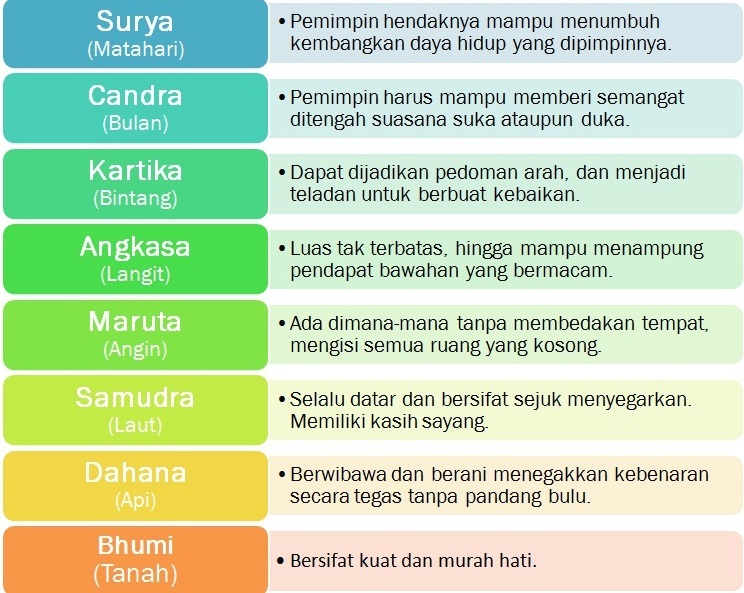
Prinsip_pemimpin

Hasta Brata, the 8 elements to lead in Javanese philosophy: Sun, moon, star, sky, wind, sea, fire, and earth. Beautiful.

Let’s leave it there. Now my next inquiry would be: is it true that “leaders are those who don’t crave the throne”?

Leaders should indeed be favored by their people’s voices. However, it is not mutually exclusive with the existence of ‘willingness’ in these leaders’ hearts to seize for authority. Matterfact, great leaders’ shining eyes come from their endless stream of ideas and enthusiasm to make it true. Aiming to have a role at the higher post does not necessarilly mean that they are greedy, avaricious beasts. It means that these people have serious concerns to realize their aspirations.

Exhibit A: Hanifah Ahmad, a friend of mine, loves Indonesian Student Association for International Studies (ISAFIS), an organization she’s been engaged with for almost a year. During the process, she detected problems in the body, and wished to make a change, to bring the organization towards betterment, simply because she feels that she belongs to that group of people. She needs to bring her thoughts forward and see how the squad would respond. However, she knows she can do nothing if she’s not there as their ‘head’.

Exhibit B: With no intention to brag or anything, I know my utmost contribution for OIS (a remarkable social science olympiads event at my campus) would be by taking the responsibility as its project officer.

“There’s no such thing as a perfect leader either in the past or present. If there is one, he is only pretending, like a pig inserting scallions into its nose in an effort to look like an elephant.” –Liu Shao-ch’i

I believe that all youngsters have the basic seeds to be great leaders. Idealism and never-ending spirit might become their foremost fertilizer, yet in most cases both fade as these young minds grow as adults. The task is then to preserve and nurture these values so that you can still feel it somewhere in your heart as you sit behind your working desk at your 30s.