How International Relations Theories Affect Us

Since there are many people who misperceived me as a literature student, I’d like to reaffirm that no, I’m not that lucky to be able to study languages. Instead, I’m happily trapped in the major of international relations. I sometimes pay unequal attention to the textual aspects in my papers, but still, the issue in my hands involve or more two state/non-state actors e.g. France and Japan–not French and Japanese (as a language).

To begin with, I’m not the most brilliant student in the class–we have someone way smarter to bear that title, but I need to reveal that I score quite amazing in our the theory class(es)–because I have a fond, very fond interest in the subject. I believe that everyone else should also experience the same excitement, so here go examples of international relations (IR) theories–traditional ones–that explain human traits:

International-relations9

1. “Great powers will ally with weaker ones.”

Or, to inverse the premise, “great powers will not ally with other great power.”

The case happens with leaders who seek for influence and glory (two main interests that states as well strive for). In simpler words, when your alliance gets stronger and threatening, you’ll instinctively leave him and find a weaker person.

Remember when Wiranto created Hanura or when other political leaders separate and build their own squad under a new party? They might defend themselves with the notion of ‘principal-differences’, but the basic objective is clear–to seek for feebler actors whom you can control and induce with your own ideas and concepts. Just as Schweller says, weak actors tend to be opportunist and willing to bandwagon.

Another model to explain this: when the staff of an organization have increased their level of scrutiny and send protests to their boss’s policies, these employees are actually gaining their strength. Their boss, the great power, instead of getting his hands dirty with problems and difficulties, will prefer to search for new people.

2. “The more number of states is, the more likely dyadic relation to happen.”

Most people will reject an invitation to join a dinner of two lovers. In Indonesian language, we call this third party as obat nyamuk or kambing congek, and it does not sound so nice. (Tell me about that.)

However, with a little (too many) experiences, I can tell that you’re not actually ignored when you go out together with a couple. Because, ladies and gentlemen, with only 3 states existing, a bilateral interaction between any 2 states will be seen by the other person, and it will make them feel uneasy about it. In the end, the situation will yield in a decent multilateral relation between the 3 states.

Yet again, when the number of actors increase to 4, 5, or 6, the number of dyadic relations will also rise along because they know that other actors are also performing a dyadic relation with another actor–yielding a perspective of ‘we’re cool here’. You see–when there’s a couple hanging out with a number of friends they’ll most likely reserve their own seats and private talk instead of bothering to talk with the other folks.

This dyadic relation is stronger especially when 2 states have a similar interest, a huge one to each other, be it romance or whatever. If the number of actors has reached dozens or hundreds, indeed these connections will occur to every possible direction.

3. “International agreement will never, ever, work.”

So back then I made an agreement with Kiki to stay up all night and finish our international relations theory paper. If you expect us to completely fulfill this agreement–you’re wrong. We’re both deadliners by nature (just as states are evil by nature), so it is just easy for us to break the ‘law’ which was based on such bilateral agreement. That night, instead of keeping an eye to Microsoft Word, we chatted and Tumblr-ed. Kiki even forgot the regulations we agreed upon. Thenceforth, agreements or laws that need a ratification from states will never be effective. I can guarantee you that.

Here I am, amazed by the study of international relations that can explain almost every phenomenon in our lives. Those three examples are picked because they happened lately. As a matter of fact, there are many other examples that I’d like to share. Later, readers.

People Talk About Themselves on Twitter

so what?

Homo sapiens is the most self-centered creature living on Earth. We’ve witnessed with our eyes how there are killings ordered for the sake of own-survival. We’ve also seen ‘ibu-ibu hamil tak berdosa’ on the train forced to stand up because there’s no single man who would give up his seat for the mere sake of helping these women.

Twitter, my friend, is just another form to manifest the self-centered nature of ours.

Twitter-logo

Some accounts are indeed designed to be jocular or informative, but most–I can’t give you the statistics, though–are private accounts which tweet about their activities on a daily basis. (This includes my own and am not to be ashamed of.)

Let me show you the problem to this notion: yes, we do seek for attention even before Twitter was there, but it doubles–sometimes triples our pretentious behavior. These sentences will never make any point when spoken, but somehow acceptable when found on your timeline:

  • Pagi ini aku mau beres-beres kamar! Yak!” (Oh yes honey I wish you luck on that, but isn’t it a habit everyone else commits?)
  • “Gue orangnya suka ngomong sama diri sendiri.” (Seeing what you usually tweet, you obviously are.)
  • “Makan siang ah…” (Whoa, is your lunch a kind of news that everyone needs to listen to?)

Again, so what? In the end the liberty to follow or not-follow these accounts are up to you. People might end up following each other just to read updates from your very-very-important regular schedules because they want to catch up with you.

Since I’m willing to make every post on this blog, at least, a bit useful for everyone, kindly absorb the following imperative to your mind: before you tweet anything, bear in mind that it’s gonna be nicer if there’s at least someone benefitting from what you share–be it a crispy noon laugh, or an opportunity to go abroad.

*yawn*

Why Social Science Matters

I’d like to start from the very background of this post: the gap between natural sciences and social ones.

Conservative–I should add ‘Indonesian’–people failed to see that social science is a science. Most of them believe that social science is just a compilation of facts that everybody can learn from newspapers. They tend to believe that:

a) It is obviously easy, everyone can conquer it.
b) Natural scientists can do whatever social scientists can, but not otherwise.
c) Social science doesn’t require you to have a certain level of analytical aptitude, it only needs people who can memorize.

As a result, the government provides youngsters with many mathematics, physics, chemistry, and biology competitions–but not social sciences. Tell you what, they’re complete nonsense.

Social science is not, I assure you, ‘a compilation of facts that everybody can learn from newspapers’, it rather explains beyond what is written. When the press announces publicly that more people are using Twitter, social scientists can tell you what it means in the future. We can explain why China vetoed a number of resolutions in the Security Council, and we analyze why some policies can’t be implied.

Social science is very challenging for its dynamics. Things that mattered for the international community during the World War II, for instance, are not important anymore in the 21st century. Trends have changed, concerns have swayed, and televisions now show different news.

Its vastly wide range of issues makes it impossible for us to solve it once and for all. Therefore, social science is broken down to a number of specific studies: anthropology, sociology, economics, psychology, political science, international relations study, communication science, criminology, administration study, social welfare study, and a lot of others to follow. This provides strategic options for future students with varying passions. Yet the silver line is clear: the interaction between agents in a certain structure of a system in the society.

Social scientists can convey a single idea or concept in more than a million ways. Unlike natural scientists who ‘prove’ one static truth, our truth moves from place to place and it takes thorough efforts to extract an abstracted truth from empirical evidences.

Those assumptions are all wrong, and these are true ones:
a) Social scientists try to answer different questions–most of them directly affect your life.
b) It doesn’t need natural scientists’ logic, but it does involve common sense and imagination to ‘construct truth’.
c) I sucked in my first year of studying social science, so it’s ‘obviously’ not easy.

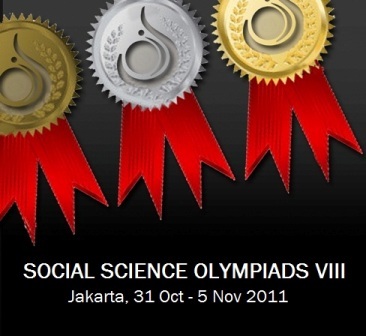
With a single hope that parents, teachers, and–above all–students will comprehend the case I, along with BEM FISIP UI 2011, am making, we hereby suggest you to spread the good news of first Southeast Asian-wide Social Science Olympiads:

Dp_bbm

Find a lot more on: http://ois2011.com
Follow our Twitter: @ois_2011

Citation Provided

Words are already beautiful when they stand alone, yet the effect gets a hundred times stronger when they line up and form certain sentences. Here go several quoted ideas that deserve a big win!

Real-simple-callout-masks

“When a language is lost—meaning no living person can teach another—a world perspective is lost. Some foreign language expressions simply cannot be translated. Colloquial phrases are pleasant to the ear, not only because they are familiar, but also because they reflect a unique aspect of a culture. … There are 50 different words that mean ‘snow’ in Canadian native language, and in the Eastern Arrerntre language of Central Australia the word nyimpe translates to ‘the smell of rain’.” —The Exodus of Language, Jessica Kwik (1998)

“Menarik lho! Misalnya, dalam bahasa Jepang untuk mengatakan hujan ada banyak kata, shigure, samidare, dan tsuyu.. Sementara dalam bahasa Inggris hanya ada rain. Tapi sebaliknya, domba dan anak domba dalam bahasa Inggris dibedakan menjadi sheep dan lamb. Bahasa Cina, kuda yang hitam disebut Han dan yang dahinya putih disebut Di. Dengan kata lain, hal yang penting dalam kehidupannya dan cara berpikir orang-orang yang menggunakan itu, terungkap dalam kata-kata..” —QED #6, Sou Yu (who sounds a lot like the SMA-me)

“I don’t write for readers; I don’t think many writers do–I don’t think any, They say they do, don’t they? But…well, I only write for myself, and when somebody says: “Oh, your book has given me so much pleasure,” I just think, “How peculiar.” I don’t know what to say. Of course I don’t say that; I smile and say “How nice.” –but I think I’d have written books whether they were published or not. I just liked writing.” —Beryl Bainbridge

“A book is the only place in which you can examine a fragile thought without breaking it, or explore an explosive idea without fear it will go off in your face. It is one of the few havens remaining where a man’s mind can get both provocation and privacy.” Edward P. Morgan

Meet Argots and Verlan

Do you recall the last time we use coded language with our peers?

I remember using ‘the g-code’ during my elementary school years. The rule goes like this: “add -g(a/i/u/e/o) to each syllable in your sentence”. Thus, “Eh, cowok itu ganteng banget,” would be “Egeh, cogowogok igitugu gagantegeng bagangeget.” The basic idea is to prevent outsiders from understanding our conversation, and this coded language was quite practical until more and more people know about it and making it unclassified enough to actually be called a ‘code’.

The Roman armies did it better. They use Caesar’s Chipher and wrote down sentences that can only be decoded by this cipher. For example, if you set the code to +3, then:

  • A = D | O = R
  • C = F | R = U
  • E = H | S = V
  • H = K | W = Z
  • L = O | Y = B
  • N = Q

So the sentence “Why wheels won cars?” is going to be written as “Zkb zkhhov zrq fduv?” making the non-intended receiver of the message who doesn’t udnerstand cryptography wouldn’t be able to read your message.

Cb-1

These codes are called argot in French. Here goes the most interesting part: today’s French youths also use argot in their everyday language through transposing syllables of individual words to create new slang words, and they name the code as verlan. In other words, verlan features inversion of syllables of a word formed by switching the order in which syllables from the original word are pronounced. For example, français becomes cèfran.

I find this fact very interestingly new, because I thought French only provides extra vocabularies for romantic lines. I did not expect French to have certain ‘style of language’ that is used by their teenagers like verlan.

Just as the information is not interesting enough, the word verlan itself apparently is a verlan from l’envers (lan-ver), meaning “the inverse”. Exactly like the fact that ‘portmanteau’ was a portmanteau of porte and manteau.

The pronunciation of a verlan generally retains the pronunciation of the original syllables with exception for one-syllable-words (poor thy). There are also words that can be verlan-ised in more than one way, like cigarette which yields both retsiga or garetsi.

So, have you met Argots and Verlan? You can go here for more information on verlan.