10 Scrambled (Pinoy) Thoughts

Magandang umaga, people. Greetings from the islands of Philippines! Here go several things that have been going on in my mind during the past week of Volunteering Program Development and Management (read: some serious stuff somehow I’m involved in) trainings:

1. Existence of threat makes you work twice harder.

And better. For the first time in my whole 19 years, I started fasting as part of the minority religion of the country. In modern English, this is translated as ‘not eating while the rest of your class hit all the great meals, at least four times a day‘. Which, at one point, tests your faith and all, but at another point, makes you feel all heroic and gives more meaning to the ibadah you’re practicing.

I remember the first time I completed my fasting. I was what, 5 or 6, and I’m quite sure that I felt super triumphant when the maghrib adzan was finally announced. It was like I tamed a lion or something. However, year by year, Ramadan fasting turned to be just like a habit that people do on regular basis, and its deep meaning started to fade—especially in my head. This year, I am fully conscious how it truly is sacred and lessonful. So yes, fasting in a Roman catholic country is really one of a kind experience that brought me back.

Oh and without any intention to be offensive, I’ve been literally praying towards a wall with crucified Jesus on it.

2. Politicians talk slowly.

Let’s name a few. Yudhoyono, Obama, Churchill…no matter how smart these people are, they most certainly have a speed limit for their grandiose speeches. What an oxymoron, right? I had always been questioning about it and I finally got the answer: they desperately need to get the right words.

One of the participants here is actually a real mayor (named Angel, wisely 59) and—believe me—he’s incredibly smart. Yet it would simply be unbearable for him to forgive himself for delivering wrong expressions. Thus instead of saying ‘amazing’ he would take extra seconds and pick ‘astonishing’, because otherwise his sentences would not be impactful enough. It’s like he sets hiw own benchmark for oral language.

3. A Chinese guy and British accent is a deadly combination.

Such description did not include the fact that he volunteered for the International Red Cross and aimed to be one of United Nations’ Peacekeeping troops. Did I also mention about how he got off the car and ran under the rain to give his umbrella to a pregnant woman? His name is Zhang (27), he’s considerate, kind, intelligent, funny, sharp, sincere, and this list of adjectives automatically made him everyone’s most favorite participant here. This guy is the kind whom girls—women, I should say, bearing in mind that everyone else is above 28—talk about during their dinner.

4. There exist people who don’t try too hard to impress everybody.

Athena (39), a new friend of mine, was a volunteer for almost 2 years in Ghana and Indonesia. By the time you meet her, you’ll understand what I’m currently trying to say. She’s—putting it in one word—kind. Excessively kind. Her kindness is like too much that you start feeling like you don’t deserve to be treated that nicely. She does not intentionally try to be kind, she just is. After the program, she’ll soon be departing to Laos for another volunteering experience. Sometimes it makes me envious, these lucky people.

5. Model United Nations infects people greater than ever.

As much as I wanted to have a bit of escapade from all this MUN stuff, it somehow came directly to my face! On the second day, we had a simulation of United Nations conference where debated on “marginalized groups are unlikely to volunteer” and I actually had a good time, enjoyed the debate and somehow managed to nail it! I think the most compelling attribute about MUN is that people are given the opportunity to represent a larger group of people, a country, with a definite yet flexible stance in their hands. All hail MUNs indeed.
Img_1080
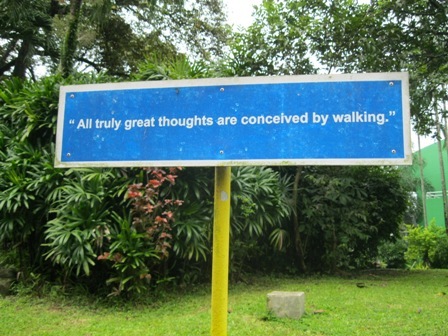
6. “All truly great thoughts are conceived by walking.”

I read this sentence on my way from the Residence Hall to the Academic Hall—and I should say I wholeheartedly agree. Somehow, when the kinesthetic aspects of your body work, your brain is more intrigued to produce ideas and thoughts. Probably this premise cannot be generalized, but is justifiable enough to talk on the average level.

As a matter of fact, the previous 5 points are several things that knocked my mind during these walks during break periods. Not to mention how much energy you can save by walking. (I can write another full post on that, haha.)

7. One of the best things about classrooms is its lack of hierarchical relations.

I mean, you can even correct your professor. Having mentioned that I’m (by far) the youngest participant in this training, I don’t at all feel ‘marginalized’ or ‘unheard’ or whatever kind of negative labels that people put on youngsters in an adult discussion. The people here treated me as one of them, who also contributed perspectives and scrutinized some points—because we’re all sitting on the same desk of learners. You know, classrooms make you realize that there will always be something new to learn. No matter whom or what you get it from, information and insight are growing creatures that require you to always listen.

8. Ignorance is caused by lack of knowledge.

People say that today’s young people are apathetic and pessimistic. I say, we simply are not exposed to the reality. How would you expect us to put sympathy and take actions to overcome poverty if what we see on the television is breathtaking sci-fi movies or cool bands? Inspire us to read, inspire us to see, maybe we’ll finally understand that there’s so much to care about.

One method in the training was doing a role play. We acted as members of village with unique background and situation, and yet we faced the same problem: the clinic was 130 km away, we were too sick to get there, and there was nobody to help us. Doing this, I was somehow able to put myself in the shoes of communities that still face similar problems today. Before, they’re just statistics—numbers that all global stakeholders are trying to mitigate but not necessarily put sympathy on.

9. When a student does not pay their fullest attention to the teacher, it’s not completely their fault.

I believe half of the problem belongs to the provider of material i.e. the way he/she presents it. Skills in creating Power Point presentations and public speaking are just two of your first steps in doing it well. I believe that most of you do not have problems with presentation delivery anymore, right?

10. Mastery of an extra language always makes you sexier.

And it is more effective than any expensive car. Despite the fact that Filipino have their own way to pronounce -ion, -ble, and -ple, the fact that every one of them possesses above-average stock of vocabularies (especially compared to Indonesian people) shape the way you perceive their thoughts as well as how they digest ideas in their brain. A jeepney driver or a janitor who speaks advanced English (in addition to their local langua
ge), in a way, impresses me better than a doctor who can only speak Bahasa.

I still have three days before my flight back to Indonesia. On Thursday, I will be presenting Indonesian Future Leaders to the floor, and I really need a bunch of luck from you so that I wouldn’t mislead them in recognizing the organization. Salamat, Po!

Development_Action_Plan.pdf

The “Talk”

Several days ago, I randomly decided to sleepover at a friend‘s place, which led us to the following post. Most of the ideas were explored better by expert psychologists, pray read to simply get trough its nutshell.

I. There exist private and public selves for each person.

I came up to her proposing a question about whether people who pretend to be kind deserve the same merits as those who are kind. What I really meant was related to the fact that there are some people who consciously do positive deeds just for the sake of doing good whereas there are people whose nature is to make their surroundings happy. I said yes, they did, because it’s actually harder for them, trying to be kind, while the second group of people don’t need to take extra efforts and are kind unconditionally. Of course, the notion changes if one has hidden agenda, interest, or intention behind theirs pretense.


38966494-bilingual

However, my friend rebutted this saying that, by nature, people do show certain level of ‘self-ness’. Colleagues or acquaintances, for instance, are only allowed to see the outer, nutshell part of your self. This merely includes your happy and organized face. At the other hand, your family or spouse have seen your dread, fear, desperation, and tears–attributes that are too personal to be shown to new individuals.

II. At which level of relationship are you?

I concluded that, there are at least three levels (she actually resolved on two):
a) friend-level-2
b) friend-level-1, and
c) friend-level-0.

Friends-level-2 are exposed to the idea that you’re an angel without any possible negative characteristic. They are not allowed to know that you’re human with problems, neither the fact that you may be angry at one or another point. This is a level shown to people you just know, or people with whom you have political (read: hierarchical) interest. The boss or subordinate, you might mention.

Friends-level-1 are mostly misunderstood as bestfriends. It lies on a too quick assumption that if you feel comfortable enough to share thoughts and feelings, then he/she will stick with you forever. At this level of friendship, you start sharing your personal ideas and stories, the fact that you can as well be weak and stupid, for the sake of establishing a friendly relationship. The people in this level are candidates to go to friends-level-0, but in most cases, they fail to.

Friends-level-0 are those who still managed to stay after you throw your shoes at them to release your anger. Of course this is an extreme example, but the point is that people at this level have seen you at your worst. You and your imperfections. You and all the emotion, negativity, as well as furiousness over a problem. Although you might have a lot of bestfriends, I bet people on average only have one or two friends-level-0.

This article might add or change the way you see people, but always put in mind that no matter how you play it, always cherish the nowness.
Have a good day!

Meet Ted Fishman

Forrest Gump’s mother always said that life was like a box of chocolate. You’ll never know what you’re gonna have.

A fortnight ago, I had the rare chance to meet this incredible guy personally. In case you haven’t heard of him, he’s a journalist, the author of China, Inc. as well as Shock of Gray. This guy was once a lecturer in Universitas Gajah Mada and is now on a two-month trip in Jakarta. He was about to treat me a Big Mac–if only I hadn’t bought my own meal.

Fishman_about

Ted: (to a mas-mas) “Terima kasih!” (“Thank you!” in Bahasa)
Afu: “You must’ve been here before. You speak Indonesian!”
Ted: “Well, actually, yes. But you only see the part of language that I know. There are parts that I don’t–and that’s a lot more!”
Afu: “Haha, alright.”
Ted: “Okay. So…”
Afu: “So, yes. What would I do, as a research assistant?”
Ted: “Well, I think I’ll have to tell you how I work. I never have specific things in mind when I decided to write something. I just talk with people–talk with almost everyone, and then I observe their thoughts, I discover the concerns that they have, and then I narrow my topic down.
Afu: (that’s pretty much what I myself do)
Ted: “I contacted a friend of mine to help finding these people…yet, instead of bringing me to the market or kampungs, he made appointments with far too great people–like the ministers and all those politicians. I don’t think I’m smart enough to meet them now. So I freaked out.”
Afu: (what a humble guy–he can’t even tell who’s smarter than whom)
Ted: “Basically, I need someone to be a translator–to falicitate me converse with real Indonesian people in the suburbs, in the market…preferably in the afternoon. Because that’s when people slow down from their morning rush.
Afu: “Well, I’d love to. I think it’ll be a great opportunity to directly learn from the field.”
Ted: “Really? Great!”
Afu: (asks technical questions)
Ted: (answers technical questions)
Afu: (nods in agreement)
Ted: “Your English is excellent, by the way. Did you grow up somewhere abroad?”
Afu: “Thank you. Nope. Actually, no. I just watch movies.”
Ted: “Wow, that’s great. So, tell me about yourself. Your interests, your dream…your plans in the future?”
Afu: “I…aspire to be a writer…just like you. An academic one, who argues about something. I also want to give lectures in classes, and I hope I can do both simultaneously. But I’m not really sure where to start.
Ted: “Well. I think Indonesia is a great place for writers. The people here are hungry for information. There are a lot of newspapers to start writing for.”
Afu: “True. But that’s exactly why we can’t tell which news is worth reading and which is not. There are too many of them.”
Ted: “Well, the thing that you have to bear in mind is that books are not newspapers–nor magazines. People buy your book because they like your idea. Newspapers and magazines, on the other hand, are issued frequently. People buy them on a habit, for example.”
Afu: “Can’t agree more.”
Ted: “I’m not saying that magazines are bad–I subscribe to a number of them. But you know, you’ll have to have the idea to sell a book.”

I don’t know what point I’m making by posting this up, but I think when you’re really great, it would be hard for you to realize that you are. He’s such an increadibly smart, family-loving, and amicable man. He has all the checklist that ladies compose for their candidate husband. I fell so fortunate to have met him in person, on a table at McDonald’s Pasar Festival.

My Farewell to the Magic World

The good thing about books is that they’ are perpetually there, right on your shelf. Whenever you miss a character or you want to relive a particular event in a story, you can always turn the pages and find that chapter. However, I believe that the first experience is what counts the most.

I have to say that I’m a proud fan of J. K. Rowling and the amazing 7 titles who is currently in a deep grief to completely say goodbye to her lifetime favorite series.

Harry_potter_septet

I first ‘encountered’ Harry Potter at the 3rd grade (aged no more than 7, I was) on–believe it or not–Majalah Bobo. At that time, my childhood magazine published an article about ‘the book to the magic world’, and somehow the description made me feel ecstatic and believed that I have to experience the story myself.

So I went to Gramedia Padjajaran and found the 2nd book (Chamber of Secrets), yet I had to put it down for the book was too expensive. My mother doubted that I’d finish the book since it had quite too many pages for an elementary schooler like me. Then I went sick.

It’s almost like a tradition in the family that whenever their only daughter gets ill, there must be something wrong with her heart–or mind. Apparently, that time, Harry Potter was the cause. Mother finally decided to buy one, brought it home, let me read on the bed, and I got well really, really soon. I finished the book within a week or more (it was a long time ago), and couldn’t wait to buy the first book (Sorcerer’s Stone)–which I did.

I grew up believing that I was a stranded Ravenclaw, memorizing little facts and names that appeared in the books, and getting mad at by Eyang because I couldn’t move a bit whenever I started reading them. I was known as a fast-reader in the class but nobody knew that it was because I got used to Harry’s heart-pounding stories. I became familiar to grammatically-English-structured sentences (translated to Indonesian by Maam Listiani Srisanti) without really being aware of it, and unconsciously gave a huge space for the magic world in my heart and mind.

Silly–corny, you might say, bearing in mind that I’m currently 19, but I always feel myself like 9 whenever I get in touch with Hogwarts and wands.

I remember buying my last copy of Harry Potter (Deathly Hallows) on the first day of its release date, the English version, sacrificed my monthly saving, and ended up in tears the next 3 days since I realized that most part of my childhood had ended. It really did.

The fact affected me in two ways: a) I was desperately hoping that Rowling would come up with the 8th book (perhaps about their aftermath life?) and b) I repeatedly convinced myself that it has not utterly ended because there are 2 more movies worth waiting for.

So I waited–and watched Harry Potter 7 part I which turned out to be stupendous. Today, the finale is being screened in cinemas all over the world but somehow God does not want me to watch it. Indonesia still has not finished its tax issues with blockbuster movie distributors. Maybe He wanted to prolong my pseudo-waiting in despair. I tried to not care too much about it because the book had ended anyway–although, it really puts me in galauness to perceive that my friends are watching it abroad and I’m stuck with my works here.

Good bye, Harry Potter. Good bye Ronald Weasley and Hermione Granger. Good bye, our not-so-charming hero Serverus Snape. Good bye and be good, Voldemort. Let’s meet up again someday. This time, Ravenclaw will play the most part.

“A book is the only place in which you can examine a fragile thought without breaking it, or explore an explosive idea without fear it will go off in your face. It is one of the few havens remaining where a man’s mind can get both provocation and privacy.” –Edward P. Morgan