When The Don’t(s) Become The Do(s)

Hi. This is Afu writing, right from the central gravity of a massive organizational chunk that she used to be trapped in. She’s now found the exit door and thus proclaimed herself free (not as a bird, more as a human who’s lost in an unfamiliar jungle—regardless, it feels great). Somehow she does not want the suffer to be tossed into a wastebin, so she agreed to share some stories that might (hopefully) be useful for whoever ends up reading this post.

Her exhausting half-year journey comes down to a single sentence: professional teamwork has a different nature, compared to the usual kinship that you develop with your friends. Thus, your perspective upon life’s don’t(s) might have to shift to a list of significant do(s) under organizational justifications.

[Disclaimer: These notions will not really prevail unless your team comprises complete strangers at the first place.]

Organization-alignment

1. Do talk about people behind their back.

Well, contextually. You see, organization is not simply about about taking the best people in. It’s more about putting the right people in the right posts. A person’s weakness as a subordinate might be the strength that a leader needs–and vice versa. So yes, if you’re cursed to be a policy-maker, do talk about your candidate staff very carefully with your board. Pay attention to your people’s SWOT analysis (Strengths, Weaknesses, Opportunities, as well as Threats), their past track record, and put each of them in the best position plausible.

Important: The only benefit of a biased–or stereotyped–judgment is time discount. Other than that, prior subjective information about a particular person will only hold you from seeing the quality of that person completely. I myself have experienced a number of persuaded decisions which, although we managed to get through it, create problematic conditions along the timeline. Do remind and be reminded that, as Ekky puts it, “Sometimes we just need to be a supporting actor, yet we can still get the Oscar.”

2. Do push people off their limit.

In the Dictionary of Organizations, it’s called ‘taking the extra-miles’. Sometimes, people–especially those who take too much on their plate–will stop achieving just because they feel that the limit is there. That they’ve done enough, and they deserve a break for it. What you need to do is telling them it’s just their illusion. If in the real life you’re prohibited to push people off the edge of a cliff, in an organization you’re pretty much encouraged to do so. There’s never, never such thing as a limit for any kind of hardwork. Do take the extra-mile, it’s never crowded there.

3. Do tell people that they’re doing it wrong.

The thing about being Indonesian is that we often feel ‘nggak enak‘ to tell people (especially strangers) that they’re doing a certain mistake–or that they can change a bit of their habit for the greater betterment of the whole organization. What I would suggest: forget your nationality. Scrutinize people’s behavior if you need to. However, you need to do it right–understand the rules. First of all, never do criticism publicly. Spare your time for a private conversation, but at the same time never make it sound personal. Let this person know that you’re saying it on a professional basis. Second of all, follow the Sandwich Theory. It was first introduced to me by Guinandra and later elaborated by Gesa: 1) start with compliments on the good deeds he/she’s done, 2) continue with things that are troublesome–those he/she needs to catch up with, and then 3) wrap it up with what you appreciate from him/her. Might look hard at the beginning, but you’ll get used to it.

4. Do utilize artificial smiles.

No matter how under-pressure you feel, no matter how upset you’re getting, smile, honey. Even if you have to fake it–thus ‘artificial’. Especially when you’re the leader. You are allowed to be uptight at some points, but remember that people lean on you. If you’re not strong enough, how would they survive? Stop blaming, take that chin up, and then start thanking, remind people what to be grateful of. Working together in a committee means living in a village where everything becomes contagious–and so are negative remarks, bad mood, as well as (especially) crankiness. Contain your anger and be that awesome self you always are. In other words, keep calm and carry on.

5. Do reject affection in any form.

Bear in mind that any kind of romantic projection with the person you’re working with, no matter how mature or capable you are in handling yourself, will only slower your work down. Slap to wake yourself up, and repeat this in your mind: You need to focus. If you’ll ever end up marrying that certain person, the time will eventually come, but that’s definitely not when there are a lot of work in your to-do-list. I might sound a bit masochistic, but seriously. Take one thing at a time. Remember this saying: “You can have it all–just not at the same time.

Some might see this article as a stupid and pretentious attempt of an indoctrination of Machiavelli‘s tenets in The Prince, but again she never forces you to follow them all. Do understand that consciously doing something with a certain intention does not automatically mean that you’re not doing it from your heart. The question is then to either miserably succeed, or to be happily mediocre. You choose.

Playing Politics in the Faculty of Politics: An Intellectual Paradox?

Social scientists are delusional people who think that they’re not part of the society and thus are justified to draw and analyze societal patterns.

The bad news is, they are part of the society that they address in their own papers, they are the subject of their own academic frameworks contended in thorough discourses, and thenceforth–most of the times–it makes their efforts in explaining social phenomena an ironic paradox.

One interesting case study for this issue would be campus’ politics, i.e. General Election of the Head of Students’ Executive Body (read: Ketua Badan Eksekutif Mahasiswa). Being a student who belongs to the Faculty of Social and Political Sciences of Universitas Indonesia means having an in-depth comprehension towards the tenets of ‘political communication’ and ‘meme inducing’ theoretically, but then having to be the subject of your own study, being part of the community that their campaigns target.

6a00e55001740b8834014e88e14a8e970d-450wi

In other words, you’re like a god who knows exactly what’s going on but chooses to play in the game he creates himself.

Well, of course, I always say that social science(s) matters because it explicates what is going right or wrong with the society, but then it also has inherent sprag that retains them from being completely–in natural science’s terminology–‘scientific’, ergo, objective.

We, naive, aspiring scholars of international relations, are often disturbed by the fact that states (even as a unitary actor) still include individuals in which we’re sadly a part of it too. The way I deal with the same paradox in international relations study is through intellectual acceptance. We might be more fortunate because, in a way, our conceptual tools of analysis are set on the level that we don’t have to deal with social scientists’ common anxiety. Still, the ‘objectivity’ issue can not be entirely resolved.

Regardless how apathetic I might appear in all of this long process of ‘democracy’, I am an avid admirer of the fundamental philosophy of social contract (all hail Hobbes and Locke!), in which politics is a mean to–using my favorite verb–‘organize’ power and alleviate chaos that might be yielded by the anarchic system of the society.

So good night, and good luck for all contesting candidates!

Indonesian Education System: Liberal-Quo-Communistic?

Last week has been one of the most amazing ones in my entire life. Hosting more than 150 people from the westest to the eastest part of Indonesia as well as the Philippines was indeed a wonderful experience, and I was blessed to have an invincible team to undergo it altogether.

Ah. In case you haven’t heard, I was talking about Social Science Olympiads, a collective attempt by BEM FISIP UI to introduce highschool students to what social science really is and why it matters, as opposed to the current presumption of ‘natural science is way more appreciation-deserving’.

After having survived such pressure on a 24/7 basis, I finally had the time to sit back and engage in one of those pointless discussions I usually conduct with Johan. This time on our country’s education system. (Kindly help yourself with Google Translate for I’m preserving the conversation in its original language, although not in its exact wordings.)

Education

Johan: “Menurutku ada yang salah sama silabusnya HIUI…”
Me: “Ohya? Apa?”
Johan: “Tapi aku udah tau Kak Afu bakal jawab apa: mestinya kan itu dipelajari sendiri…”
Me: “Emang pertanyaannya?”
Johan: “Aktor. Kita nggak belajar aktor hubungan internasional. Misalnya negara, ada negara apa aja di dunia aku belum tau.”
Me:Well, jawaban gue persis yang lo bilang tadi.”
Johan: “Tuh kan.”
Me: “Gini bukannya. Dari 12 taun SD sampai SMA, kita di-expect buat nyerep informasi yang given sebanyak-banyaknya. Tanpa boleh nge-scrutinize, tanpa boleh opinionated. Nah, barulah waktu lo kuliah, you are allowed to analyze and make your own conclusions.
Johan: “Tapi menurutku harusnya itu tetep jadi bagian dari tanggung jawab institusi. Sistem kuliah kita ini terlalu liberal, gitu loh. Kita boleh milih ilmu apa aja, bilang apa aja, tapi nggak di-equip sama informasi yang dibutuhin.”
Me: “Iya sih, apa ya bahasanya… Waktu SD sampai SMA itu kita disuruh bego, dicekokin ilmu tanpa boleh protes… Eh, tiba-tiba waktu kuliah disuruh bebas. Jadi kaget.”
Johan: “Iya, itu kayak nyuruh kita terbang padahal nggak dikasih sayap!”
Me: “Persis. Selama 12 taun sistem ilmu-nya sosialis…”
Johan: “…komunistik?”
Me: “Iya! Itu bahasanya! SD, SMP, SMA komunistik, mendadak kuliah disuruh liberal. Makanya jadi ngaco. Kalau mau liberal, ya liberal dari awal. Kalau mau komunistik, ya lanjutin terus sampai kuliah beres, sampai kerja.”
Johan: “Iya kan…”

In short, we came to a realization that Indonesian education system uses two distinct bases (namely ‘communistic’ and liberal ones), which sadly cut the continuation of our learning process. Since the inception of school–back in the elementary–we were used to indoctrination of ideas and knowledge while, all of a sudden, our universities set us free, unequipped with any skill to join value-free academic discourses, and pick the beliefs of our own. This, we argue, might disturb the acceleration to students’ information assembling process and is not the best strategy to opt at the status quo.

Me: “Kalau gue nanti jadi rektor, gue ubah semua sistem kuliahnya jadi lanjut komunistik aja.”
Johan: “Lah, nggak yang SD aja dijadiin liberal?”
Me: “Itu kalo gue jadi Menteri Pendidikan, which is less likely to happen.

Well, this afternoon I suggested this piece of thought to Kiki and she argued that highschool was therefore the transitional phase where the students could have their choice on natural or social science as their focus of study. Yet again, such ‘freedom’ was served under the constructed superiority of natural science, which leave these students clueless about what they’re ought to opt for. Dear young social scientists, let’s meet up and find a way to promote this beautiful branch of study, shall we?

P.S.1: As you might have recognized, I–like Plato–am a supporter of dialogue-based posts/books. I believe that the best knowledge is produced through the Socratic method of inquiry and debates between individuals, and thus the process, i.e. dialogues, is too valuable to be abandoned and unrecorded. Plato himself had worked on as many as 36 dialogues, most of which depicted Socrates’ philosophical conversations.

P.S.2: It is very interesting that Sundanese, the language of the tribe to which I belong to, happens to not possess a word for ‘hungry’. This might show their humbleness–or better yet, how rich their land is.

P.S.3: My friend Tama has a beautiful concept of scientists’ social responsibility in comparison to corporate’s social responsibility. The idea is, simply put, you owe the society a contribution in return of the knowledge you gain or the intelligence you develop. Because, you see, those complex sets of information attached in your formerly empty brain is a result of intergenerational endeavors. Ergo, you can’t just have them all without giving back to the society.

Good night!

Roosevelt and Meyer Might Have Shared the Same Childhood

By ‘Roosevelt’ I mean the great president of United States, Franklin D. Roosevelt and by ‘Meyer’ I refer to that lady who wrote Twilight Saga, Stephenie Meyer. Let me commence a series of tweets I posted yesterday:

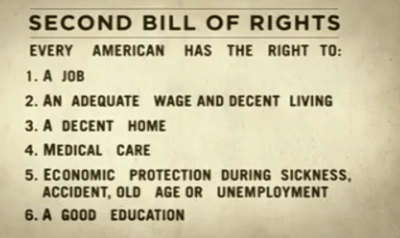
Fdr-bill_of_rights

  1. Today over a lunch, @aswinprasetyo enlightened me on Roosevelt’s Second Bill of Rights which was exactly what I’ve been suggesting to @rizkiyuniarini:
  2. Instead of giving the ‘right to create, freedom of speech, etc.’ under the spirit of liberalist capitalism, the government needs to take the responsibility…
  3. …to let their people have the ‘right to employment with a living wage, freedom from unfair competition and monopolies, housing, medical care, education, and social security.’ In other words, it echoes the spirit of socialism.
  4. Kiki believes that socialism isn’t the answer for you’ll only turn people counter-productive and ‘not happy at all’. But then…
  5. One thing liberalism doesn’t realize is that not everyone stands on the same starting line and thus has limited access to sources of wealth.
  6. Seeing the ‘Bapak-Tukang-Bakpau-Yang-Jam-9-Dagangannya-Masih-Sisa’ or ‘Adek-Jam-7-Koran-Masih-Segepok’, I’d rather be unhappy in unison :(
  7. If Roosevelt was still alive by now, I would definitely be his Second Bill of Rights’ biggest supporter. Change should start from the U.S.
  8. I’m not a fan of Stephenie Meyer’s, but ‘The Host really has an interesting concept of a ‘mature society’. A utopianic idea, really.
  9. 1) Get the concept of ‘money’ and ‘wealth’ completely erased from the society. 2) Let everyone take a job they please and produce goods.
  10. 3) Now that everyone’s assigned to a certain role, take things you need and leave those you don’t. 4) Voila, peaceful equality for everyone.
  11. Still hard to imagine? Visualize yourself getting into a store after 8 normal hours of work and take a roll of tissue, don’t pay, get home.
  12. Why can’t people stop being so pretentiously obsessed with money and wealth? Why do we create gaps we don’t want?
  13. And yet here I am, one powerless girl giving up to what the society offers me. Guess I’m no Karl Marx or Franklin D. Roosevelt.

Will be beyond glad to have this discussed with you over a glass of blended green tea with cream. Until then, have a great day.

Just a Normal Session with Socrates’s Descendant

One day he came into the class and mysteriously wrote on the whiteboard:

“Does a gate function without a wall?”

Which left the class–at least me–fallen into a minute of silence. And, as he assembled his lecture tools (i.e. a Mac and its projecting LCD), his eyes swept the entire room, searching for answers.

(Disclaimer: some parts of this dialogue might be overmade to get the dramatic impression.)

PM: “Anyone?”
FU: “It doesn’t. A wall is required to protect what’s inside it.”
DK: “I think it still does, because people get in and out from the gate anyway.”
PM: “Well, a realist would say it doesn’t, a liberalist would say it definitely does, and a constructivist would rather say that it might function without a wall.”
[With that, he began a class on Fukuyama versus Huntington.]

Plato-socrates2

Plato and Aristotle–just walking around.

Plato’s mighty master of mind, Socrates he used to be called, was a great philosopher of his time who–simply put–ask questions to make his audience think, which is a humble way of messing with people’s minds. That rare trait, as it turns out, has (re)appeared in one of my favorite lecturers this semester. A brilliant guy who undoubtedly has done his readings, the kind of a nice person who inquires for your opinion in order to put out his own agenda from your answers.

In addition to this exceptional characteristic, I finally found another human being who, like me, approved the idea that bahasa Indonesia is such a mess.

PM: “So in English, we have breakfast, lunch, and dinner–each of which to determine a certain time-framed meal. While in Bahasa, we have makan pagi, makan siang, and makan malam–you can translate that as eat morning, eat noon, and eat night.”
Class: [laughed]
PM: “This reflects how Indonesian people basically eat whatever they can get their hands on, at whatever period of the day they can actually manage to find it. On the other hand, European languages show their superiority as a civilization. We weren’t prepared for complicated syntax for any coherent cultures.”
FU: [silently nodding way too much]

Just when I thought that was all, he continued.

PM: “My discussions with Mas Edi were mostly around the notion that language was a perfect tool to gain resources. In Russian, for instance, one can not say that this glass is ‘mine’. Right, Afu?”
FU: “Well, I’m convinced they have different pronouns to describe possessions…”
PM: “Exactly. This is a way the government put a control over Russian people under their system, where private property becomes a scarce privilege that you can hardly have.”

The course has been pretty much revolving around intersubjectivity and the (supposedly threatening) absence of truth upon identities. It is therefore unfortunate that we don’t have that many people in the class to contribute their own pieces of mind and arguments to enrich our weekly discussion.