A Personal Note on Reading

One can brag so much about how they love reading and you are permitted to ignore them—only until they successfully describe to you, in details, upon what they actually love about it. This post, however, is not an attempt to convince you about my perpetual fondness to books (I don’t think that’s even necessary), but rather a casual narrative on how this affection of mine develops.

(Not that you should care about it.)

1340236073389866 (1)

Before we march on, allow me to confess this: in my 18-year career of reading, I’ve always carefully tried not to make an impression that I belong to the group of readers who pretentiously call themselves ‘bibliophiles‘, ‘literary aficionado‘, or the alike. It’s not because I particularly hate them or anything—I guess it’s just that I think labeling yourself with communal pronouns degrades the sacredness and intimacy of reading. It’s like cutting off that ‘reading’ branch from your ‘personal pleasure’ tree and add it on top of another stack of other people’s branches. In a less hygienic analogy: sharing a common name to call yourself is like sharing your clean toilet with the public. It’s not a sin, but I’d prefer to keep mine private—if you know what I mean.

Lately, though, I fell onto one of those middle-class traps of enjoying the phony habit of regularly uploading a stream of pictures—only instead of unconsumed foods, I take unread covers as my object of photography.

Anyway. About what reading means to me (I might get sentimental along the way):

1. A Mind-Capsule Where Time Stops

Does anyone actually remember the time when they first learned letters, spelled them out, and read a ‘b-o-o-k’? (Or a ‘p-a-r-a-g-r-a-p-h’, on a less ambitious note?) I’m pretty sure that mine started on a Thursday when I was 3 years old, because Thursdays were the days when Abang Koran in my neighborhood always had a new issue of Majalah Bobo. The family rumor has it that I wanted to read the magazine so badly that I learned to read overnight or something like that.

Regardless this blurred fact, I have no doubts that from then on, I have created this mind-capsule into which I can silently enter—all by myself. Sometime in the course of developing its shape and volume, time had stopped forever inside. Even when I visit it today by reading the most philosophical novel like Anthem, the girl reading it is still that innocent teenager who thinks (in the present tense) that she belongs to Ravenclaw and that some heroes deserve better. The hours that you spend while holding an open book doesn’t count—it paused; not like a broken clock, but simply because there are things more profound than the number of ticking seconds that should be measured. Things like those new, exciting thoughts and ideas before your eyes.

Then I realized that there are only two kinds of time: one before you can read a book, and one after. And believe me, the world is so much brighter and more colorful in the latter.

P.S. I love this #joyofreading project by The Economist.

2. A Thought-Silencer That Actually Works

Nocturnal people know it better: it’s not some disease called insomnia, or deadlines that keep us anxious; it’s just that our minds can get so loud that in the extreme cases, we cannot sleep at night. Experienced over-thinkers often find it troublesome to relax because they are bombarded by this new questions or memories on a minute-basis. And such anxiety isn’t exclusive to times when you’re supposed to sleep, but also in the middle of the day when you’re supposed to
carpe diem and loosen up.

Different people have different methods to silence this inner-voice down. Some put on their headset, sketch pictures on a fresh paper, or take it out by talking to their partners. Having tried various alternatives, however, I found out that the little domain inside books is what works best for me. It’s one of the magic tricks that books perform on us: they know how to control the noise inside our heads. The most powerful paragraphs can shove the resistant loud completely off, and let us enjoy a little peace of mind for a while. No wonder many of us have to read something before bed.

I believe that reading should not make you feel lonely—alone yes, but not the sad kind of alone. More like the happy one—ask the introverts around if you don’t get the phrase ‘elating solitude’.

3. A Travel-Company Who Doesn’t Mind

Saying that I hate traveling would be a lie but frankly, unlike the majority of Indonesians, I don’t cherish it as much. I like being in a new place, interacting with strangers and all, but spending hours in trains or planes sounds like a downright ‘wasting time’ to me. Thank God there are books—not music, not games, just a proper, volume-adjustable sound coming from the story-plots in those romance novels or thrilling fictions.

To count, there had been at least a thousand times that my parents told me to close the book I was reading at the back seat. They told me that reading in a moving car would impair my eyes and make me feel dizzy. Until today, I’m not sure if I wear glasses for that habit, but I’m pretty sure that ‘not reading’ would’ve made me feel dizzier. (Later they argued that I should enjoy the scenery and appreciate the world outside, but I just couldn’t help it that I was more interested in what happened
in the next chapter.)

As I grow up, I travel by myself, and people still think I’m crazy for reading in a boat or a bus, but seriously, the story of A in Every Day is more compelling than some polluted sea. So pardon my ignorance and take some pictures for yourself.

Oh and I also develop this skill of maintaining balance on a moving MRT/Commuter Line without having to grip on the holder because both of my hands are busy turning pages. It’s twice fun and challenging when the train is crowded.

4. A Natural Identity—and Conversation Supplier, Too

I am aware that people have said things about me—be it good or bad stuff. Having this consciousness, however, does not help me in any sorts to figure out my own identity. Because truth be told, I’m never sure if I was what people thought I was—you know, all those humbling adjectives. But when it comes to books and reading, I know for sure that I love the time I spend reading them, or just going to a library, or a bookshop and buy nothing, or stacking as many as possible to my worn out bookshelves.

‘Reading’ has become a natural identity to me, one that I’m confident in telling people about. Look. I’m not sure if I care about Indonesian youth, I’m not sure if I am to become a diplomat or a journalist, but I know that I love books, and I will continue reading them until my last days of living.

know it as a fact, and it’s such a relieving instinct.

And books don’t stop there; they also generously donate comfortable topics for conversation-starters like, “Hey, have you read [book title]?” and things usually go smooth from then on.

5. A Radar to Find the People of My Kind

I always believe that preferences are assistive elements to indicate who we are. I mean, psychologists have worked their ass off to categorize personalities into sets of four-colored boxes (choleric-melancholic-sanguine-phlegmatic or Jung’s idealist-rationalist-artisan-guardian are two examples), but I think the kind of books or the music you enjoy best can equivalently reveal who you are. Primitively, this also means that preference to ‘read’ than to ‘travel’ can also tell a person’s personality. In other words, understanding what you prefer is a way to peek inside yourself.

My preference in reading, apparently, has guided me to find a bunch of lovely people with whom I can spend hours asking questions and listening to their awesome ideas. Two months ago (or more, I’m not sure when it started), we decided to gather and discuss about the books we read, or a bunch of unrelated thoughts about which we somehow had the urge to discuss upon. The latest one is available on SoundCloud, although it was too philosophical to be called a typical book club discussion. We call these meetings #BookTalk, because well, it involves a lot of talking about books. (D’oh.)

By the way, you can email me if you’d like to join our next lunch.

6. A Beautiful Mess of Mind-Twisters and Heart-Exercisers

There are times when books drive you crazy. Like when Mr. Darcy sweeps you off your feet, or when you wanted to shout to Dexter Mayhew’s ears that he should’ve realized sooner that he loved Emma Morley. Some other times, they make you angry because what you find in a book has stayed in your own mind for a long time, but its author just stole it away from you like that. And worse, they actually present it better. (I detested de Botton’s Essays In Love and Levithan’s The Lover’s Dictionary only because I love both so much.)

At the same time, reading also induce new thoughts and develop the existing ones to a certain level of complexity. It surprises you with new plot possibilities, calm you down with answers to your current problems, or inspire you to take new habits. Ayu Utami is one of the most talented ones in doing this, not to mention Chris Cleave and Dan Brown’s in-depth-research-supported thrillers. The feeling of going through all these tangled thoughts and ideas, having multiple braingasms until you reach the end and close the hard cover of that copy, is indescribable.

A little tip: read classic books. Remember: swimming in  first-hand thoughts (not reviews about them) is an inalienable right every reader has to claim.

7. The Truth

7.1. I don’t read 7 books in a week, okay. Stop assuming that all bookworms read unreasonably plural number of books—they read a lot and they read more than you do, but it’s not like they are bestowed with a superpower to have all the time in the world to read every single book written. The trick is this: the most clever readers don’t settle—they stop reading when they know that a book is crappy. And crappy books do exist. The smartest readers don’t read certain titles because the whole world is talking about it (exhibit A: Fifty Shades of Grey—no offense, E.L. James), and they know the kind of books they truly, sincerely love. I myself read a couple of books whose first chapters compelled me. Then I swam deeper before I’d bore my friends with all the new thoughts and ideas that
I discovered in the ocean.

7.2. I read fast, but it doesn’t mean that I don’t read wholeheartedly (people usually accuse fast-readers for that—maybe out of jealousy). It’s plausibly an inevitable skill trained by years of practice. There are, however, some paragraphs that takes your eyes off the book because you need to reserve a couple of minutes to exclusively ponder about it.

7.3. Reading English books doesn’t make an Indonesian reader a snob who ‘does not love their own country’ (don’t you even dare give me that nonsense), but again, people simply have preferences. Sometimes we have to accept that certain kinds of readings, languages, or themes are more intriguing than the others. I read many English books, but I pay my fullest respect to Pramoedya Ananta Toer, Goenawan Mohamad, and Eka Kurniawan, whose amazing works always humble me down.

7.4. Lastly, I’d have to do just to the Singaporeans (whom I badly judged in this post) and admit that they do have wonderful people who care about thoughts, ideas, and books. I learned this especially after I visited some of the awesomest literary enclaves in Singapore, including Littered with Books and Books Actuallyboth restored my faith in their local literatures.

“A book is the only place in which you can examine a fragile thought without breaking it, or explore an explosive idea without fear it will go off in your face. It is one of the few havens remaining where a man’s mind can get both provocation and privacy.”
—Edward P. Morgan


The Two (and a Half) Generations of Indonesian High-Achievers

Lately, there has been a plethora of economic discussions upon the power of middle class, how this bulky chunk of market will determine a country’s growth or, even bigger, the future of global power houses. Being world’s 4th largest population, Indonesia has also been enjoying a significant increase of its ‘kelas menengah, demonstrated by a robust, consumption-driven economic growth, owing to newcomers who can now afford things they couldn’t before.

Despite this amplified national productivity, our participation rate in higher-education still hit a low bar of 18%. It means that only 1 out of 5-6 young people you meet had been accepted to pursue a degree from a particular college or university. Now what suddenly becomes intriguing to me, is how there are patterns pertaining to this 18% bachelor candidates who continue their study both domestically and abroad, especially those who are perceived as high-achievers by their surroundings.

I believe that a proper grouping would be as follows.

Price Cutting at the Bottom of the Pyramid1

I. The First Generation High-Achievers (FGHAs)

In it are students who come from either lower or middle class parents who are informed enough about the importance of education, and want their children to perform better in the future. Ones coming from a relatively poor home are hard workers whose nuclear family depends on and simultaneously is very proud of. They are among the firsts in the family tree who have the opportunity to attend undergraduate courses and able to speak English fluently, not to mention their long list of achievements, each of which is a big news to celebrate back home.

Those coming from middle class parents, on the other hand, are often simply bored by mediocrity, and—often stimulated by their environment—challenged to push themselves to the limit while trapped in the addictive happiness of self-actualization. Having a constant, unlimited source of motivation to keep moving forward, these people generally do not find it hard to remain humble, because they know exactly how half of success actually comes from opportunities and they’re simply blessed. Exceptions are always there, however—some FGHAs, drawn into too much compliments, think they deserve all the admiration and go for arrogance instead.

II. The Second Generation High-Achievers (SGHAs)

I love the SGHAs. Compared to FGHAs, they are less roller-coaster-ish, in the sense that ‘high-achieving’ has somehow transformed into a culture in their upper-class family.
At the same time, however, this also means that their overall stories are more boring (*dijitak*) because they were born with a silver spoon in their mouth, i.e. granted the access and support from their parents in achieving their ambitious life goals. Let’s not be too judgmental but fair at the same time—having smart phones, notebooks, or cars does make things easier to handle. Beyond this physical, wealth-related facilities, there are also direct moral guidance from a living model of success—a privilege that most FGHAs do not possess. I believe that living with certain kinds of people under the same roof brings a huge difference in the way you think and react; so living with a businessman who spent a couple of years in Harvard, for example, must’ve meant something.

Part of that high-achieving ‘culture’ which FGHAs plausibly have to learn, is that a display of achievements does not necessarily mean that a person is snobbish. I’ve just learned this a couple of days ago. Just as exhibiting a new jewel is normal for English ladies of wealth, for example, the act of ‘letting you know about my latest accomplishment’ is also a mere habit—although a too far generalization should not be made at this point. The luckiest SGHAs (and I know many of them) were raised with virtues, and that includes humility.

II.V. The One-and-a-Half Generation High-Achievers (To Make It Fair)

In some cases, there exists a transitional generation whose parents are too successful to make him/her be categorized as FGHAs, but also not wealthy enough to be deemed as part of SGHAs. These people, if determined enough, are going to be the passage way who will give birth to the SGHAs. Like all transitional categories, the one-and-a-half generation high-achievers can adopt both natures, toss away one of them, or simply combine them into a new mix of traits. I personally see myself as part of this group, all the reason why I insist that this should be added to the initial dichotomy.

Q1: Why Aren’t There Any Third Generation and So Forth?

Good question, self. LOL. Well, I’m afraid it’s because: 1) I haven’t collected enough data to claim that a pattern also exist for third generation youth, 2) if I should claim that such pattern exist, it’s too identical with that of the second generation, or, in a bigger picture, 3) Indonesia hasn’t been prosperous for long enough that it has third generation high-achievers (we’ve only been independent for 67 years after all).

Q2: How Is This Judgmental Postulation Related to Human Development?

What I’m trying to say is that:

  1. All great civilizations root from home.
  2. Macro human development is about producing more SGHAs.
  3. Indonesia has one of the slowest pace in doing this.

It takes an adequate number of FGHAs to produce even more SGHAs. I mean, in order to induce ‘high-achieving’ as a culture in your home you will need someone in that building who has experienced it him/herself (i.e. an FGHA), an essential element that you cannot skip. Consequently, we need to produce more FGHAs. In other words, if Indonesia wants to grow effectively and become a great nation with dignity and big visions, then there’s a process we have to undergo over here.

Having been very happily engaged in inspiring conversations with many FGHAs (and SGHAs), I should say that the hope is there. Seeing Indonesia at full throttle and her best performance is a dream current FGHAs and SGHAs fondly possess in common, I think, and it might take a while but we’ll be there.

P.S. Some one-fifth of this discovery’s credits (as well as 82% of my confidence to publish it) go to Ipeh, Kiki, and Diku for having listened to me during the cinema queue back then as well as yesterday’s Starbucks ramblings.

And of course to you too, for reading it. Good night.

A Month In Singapore

For a person who creates a big fuss about almost every phenomenon around her, the fact that I barely learned something new in the past 30 days surprises me. You see, even a week in New York or 10 days in Manila had stimulated a lot more thoughts in my head than spending hundreds of hours in this very City of Introverts. For a while, I wondered whyafter flying forth to Manhattan and back, I finally understood.

(Well. Not much, but let me try.)

Flapboard
A motion-flapboard (like those in the airports) displaying a 3D-poetry
entitled “24:00:01″—a time that does not exist, or a space beyond
conventional boundaries. (Shilpa Gupta—Singapore Art Museum)

1. One Has to Open Their Hands to Embrace

To be fair, half of the blame should probably go to myself for having fastened my opinions on Singaporean people too quickly. I made my judgments, and as soon as there were enough evidences to support them, I concluded that Singaporean minds were not worth exploring. Even more horrible, I did not believe that these people even possessed the so-called ‘minds’ to start with. I assumed that, living under a ‘democratic’ system that does not allow media nor anyone else to strongly oppose the government, this city-state is crowded by either hypocrites or apolitical individuals. Both categories of which did not seem to interest me at all.

I hope no Singaporeans feel offended because clearly I was wronged.

I erred not in the sense that “Singaporeans actually care about politics and the fundamental aspects of being a human!” though, because truly they don’t (by all means the sentence sounds pretty funny). I was incorrect for denying the compelling characteristics of pragmatic heads that these people own. I mean, I cannot really bump into someone on a train to Littered with Books and talk about whether or not the United States has the obligation to protect the entire world, but it really is fascinating to observe two Engineering students, being acquainted to each other, engrossed so much in their gadgets and barely made the effort to converse (that was sarcasm, by the wayyou will frequently discover scenes like this). Well. What I wanted to highlight was their ingenious ability to develop experiential strategies e.g. personal methods of pre-exam cramming, intra-organizational communications, and/or inventions of shorter terms to quicken linguistic impracticalities.

Their level of attention to heuristic issues is exceptionally high, especially in ensuring effectiveness of worksprobably owing much to their already high standards of convenience in basic needs.

So, yeah.

2. One Distraction Is Already too Much

Despite my physical existence in the Land of the Merlion, my mind had always been somewhere else. My first week in Singapore was devoted a little bit too much to homesickness (Skype calls almost every night) and the following ones spent mostly with: 1) the guilt of not at all dealing with Mr. Thesis, 2) pre-Boston preparations, as well as 3) excitement for being able to work together with G20 Youth Indonesia fellows.

Unlike other exchange students who travel abroad in their weekends (casually exploring Southeast Asia on Saturday and back on Monday isn’t much of a big deal for them), I was stuck in my room, doing absolutely nothing else than: 1) reading books—which I don’t regret, 2) sending/replying emails, and, basically 3) glueing myself in front of a laptop trying, in vain, to be productive. I have to admit that ‘presence’ isn’t exactly what I was throughout the past weeks.

3. Also, I Was Too Busy Making Mistakes

The sophistication of Singapore’s daily technology can be overwhelming for some people. I myself had wasted tens of dollars due to my being uninformed (also, embedded stupidity) in using this supposedly-cheap facilities. The-you-don’t-really-have-to-buy-another-Nets-card, the phone-ordering-a-cab-charges-you-three-dollars, the no-change-if-you-pay-by-cash-in-a-bus, this whole business of lifestyle can be more complicated than you thought they would be. (Okay that was purely me being Indonesian.)

4. ‘Ideas’ Aren’t Really the Currency Here

Don’t get me wrong.

What I really want to convey is, carefully speaking, that ‘inspirations’ (or other forms of abstraction) don’t exactly matter for the people of Singapore. Of course, such premature premise is only based on my limited exposure to the customs (I attended public lectures, in-class discussions, club activities, and a series of luncheons but that’s that) so please keep your subconscious unbolted for alternative possibilities.

I don’t infer that Singaporeans (Chinese, Indians, and Malaysian migrants thereof) aren’t smart—they are outstandingly clever and hard-working—what they don’t really do is to ‘aspire’ or talk about ‘dreams’ as loud as we do in Indonesia.

I mean, they definitely have ideas on what moral nihilism is (I’m taking a course on Moral Philosophy), or how The Strait Times has been shaping opinions on the Punggol by-election (from a seminar on Media and Politics), or ambitions to make SGD 100.000/year, but, you know, authentic, idealistic notions like “youth should become the agents of change” or “we need the kind of leadership that allows personal development”—these principles don’t make a case here. As long as there’s a utilitarian value to something, one will simply shut up and do it.

5. Because Prosperity In the Setting of Peaceful Coexistence
Does Not Require a Mutual Sense of Community

The following sentences might not necessarily relate to the previous point, but: 1) Singapore is a country of (mainly) Chinese, Indian, and Malaysian people, 2) the fact that they use English as their national language does not mean that they use it on a daily basis—whenever possible they would prefer to use Chinese, Indian, or Bahasa Melayu instead—making it harder for each group to understand one another’s way of thinking, and 3) although they appear to ‘live in harmony’, I deeply doubt that they are open to accepting differences or would go for pluralism at all.

The last point became twice evident to me as I got back from Manhattan last week. There, I could effortlessly be my complete self without the fear of being judged, nor a necessity to seek for conformity from the society. You see—the label ‘New Yorker’ does not just require you to have tolerance, it is reserved for people who actually celebrate differences! Begin a conversation with a stranger in Times Square and you’ll see what I mean. Here in Singapore, however, you cannot really trust anyone.

Let’s try to be a little more systematic and commence with how Singapore and Manhattan are similar. First, they are both lands filled with people from different ethnicities (races, skin colors, you name it). Two, in many parts of the world, their citizens are famous for being determined and reasonably individualistic. Three, both lands are relatively developed—in the sense that they run an advanced transportation system, hold high standards of living, etc.

Now let’s move on to how they are different. First, of course, as much as it might be hard for a New Yorker to understand an immigrant who keeps talking in his/her mother tongue, the nonnatives can trust the New Yorkers, being aware that they only speak English and they cannot conspire with one another to fool you in front of your nose. Whereas the New Yorkers, of course, has this natural call to cherish humanity and collaborate. Having the entire city-state speaking four different languages, however, a newcomer does not simply have the confidence to feel ‘accepted’ or establishing bonds with a Singaporean-native.

Second, there’s a world of difference between the kind of ‘individualism’ (to strictly distinguish it from ‘selfishness’) that prevails here and there in the United States. Here, I think, people literally don’t care. I’m not saying that ignorance is a vice. It’s just that—people here prefer to mind their own business, especially in the public domain. Again, the government, private companies, as well as students in Singapore do have various kinds of community service projects that aim to help the disadvantaged and all—I’m not saying that they are mean, it’s just that they set areas of where they want to be involved and avoid. Whereas in New York, you know, random kindness like a guy offering to help you with the suitcase in the Subway is not much of a miracle.

6. Still on Language

Another obsolete joke about Singapore would probably be upon how they mutilate conversational English into these Chinese-grammared sentences with English vocabularies. The ‘what‘(s) they put in the end of an informative statement, the ‘lah‘(s) when they give up arguing, or how you should never ask someone to do you a favor. Will make another post about Singlish if I can find the time.

***

I’ve probably spoken too much. Remember that this post is just a shallow observation based on limited exposure on the society of Singapore. A lot of people might disagree. But it was honestly the way I perceive the meta-social bits before my eyes lately.

Also, this is my debut on WordPress! It (still) sucks that Posterous is closing down.

P.S. I’m learning German and it’s intriguing that they have five different ways to indicate that a noun is plural. Probably quantity matters so much there. Good night!

On Birthdays: Because We Deserve to Feel Special (At Least Once Every Year)

I can’t be the only person on earth who thinks that it’s weird how each of us is too much familiar with a single date, right? If you’re around 20 years old, my closest estimate is that you have put that day-month-year sequence at least a hundred times—on your university applications, visa sheets, identity card form, phone card registration, magazine subscription, online orders, bookstore membership, bank account requests, and the endless list goes on.

Many people indeed use their birthdates as passwords, door sign decorations, or pretentiously engraved on their classic iPods. It appears very natural that we feel so connected with that set of numbers that people don’t really put into account that it is an interesting issue how it’s almost as if there’s an automated machine in our head that tells our hands to write a certain date (in my case it’s January 25th, 1992) everytime we see the word ‘birthdate’ on a sheet of paper.
Frankly speaking, when I actually arrived on that day of the year—four days ago, to be exact—to actually live and experience January 25th, is something funny enough for me to think about on a yearly basis.

Salomon_copy

This imagined association with the date eventually grows into something bigger—horoscope-based personalities and lucky shios, for instance. I’m a fan of neither but sometimes I find it charming how such patterns do exist around us (and can actually be justified if you can just close your ears tightly against counterarguments).

By the way, those paragraphs are in fact just an irrelevant prelude to my actual points (which are just as useless) on the functions of a birthday (at least according to a majority of pretentious girls—yours truly included). LOL. Enjoy.

1. It’s a Free of Charge, All-Day Pass to “The Land of
Being Romantic without Looking Silly”

And by ‘you’ I don’t only refer to the birthday boy/girl, but also the people around them. Their partners, bestfriends, sisters, brothers, each family member—they are now allowed to display their affection even in the grandest gesture without judgmental stares upon such action. I mean, we wouldn’t normally cook them breakfast (not to mention the room-delivery service stunt) or buy them flowers or hide nice messages under their pillow but hey it is perfectly legal and socially acceptable to do so on their birthdays. Oh and that cute crush of yours might actually be glad to be treated overly-well on their special day.

2. It Scans and Categorizes People Into Boxes of Friends
(Who Actually Care/Not about You)

Less emotional minds would probably disagree and say something like, “Come on, birthdays aren’t the only opportunity to show how much we care about someone,” but I’m one of those reasonably sentimental females who believe that people who don’t bother using their free pass (refer to #1) and actually make efforts to appreciate your special day will never do so in any other day.

Unless, of course, he/she is a natural-born romantic who demonstrates fondness every now and then. Although, logically speaking, a natural-born romantic naturally does not miss annual free passes.

3. It Reminds You about How Much Mark Zuckerberg Has
Changed the Way We Send Birthday Cards

These days, people stay up late on the night of their birthday or one of the days after to reply a long list of one-liner ‘happy birthday’s on Facebook and Twitter. Oh wait this one is hardly significant; let’s just go on to the next point.

4. It Allows You to Make Use of That Exciting
Drama Course You Took in Highschool

Let’s be honest: there are times when we know that our friends are to give us a surprise, but we chivalrously pretend that we didn’t know and make that surprised face anyway. Or oftentimes, when we’re not really in the mood for celebrations, we have to still look thrilled—or at least grateful—that there are people who still care about our happiness. Birthdays remind you to be an adult (and thus wiser)
in such a practical way.

5. It’s a Human-made Marker of Life’s Uncertainty

On a more serious note, of all the things that people can relate to birthdays, I think they simply are nice, honest time-markers that remind us of how far we have gone on the track of life whose end nobody knows. Some people can see it as a victory to pass another year without meeting death, some others become more spiritual as they understand things they previously don’t, but I am quite sure that it shall mean something to reach a particular age.

I’m not sure about how far my life-line is, but two decades is surely a long, long time. This year I commemorate being 21 by having lunch with a nice professor, cooking a super-moderate dinner for (and with) close friends at the hall’s pantry, blowing candles on a surprise cake from two girls who spend hours just to get to my campus, and watching over this sweet video my nice friends made me.

Well. We do deserve to feel special—at least once every year. It’s not about being special—each of us already is, but about feeling so. If any of your friends is having one in the near future, my advice would be this: use your free pass and make him/her happy. It’s a free pass, you got nothing to lose! Oh and happy upcoming birthday, fellow Aquarians. Good night.

3 (Not So) Quick Steps to Self-Discovery

Although the bottom line of this post occurs to be that obsolete you-have-to-get-lost-to-find-yourself wisdom, allow me to offer you a step-by-step guide on implementing such claim.

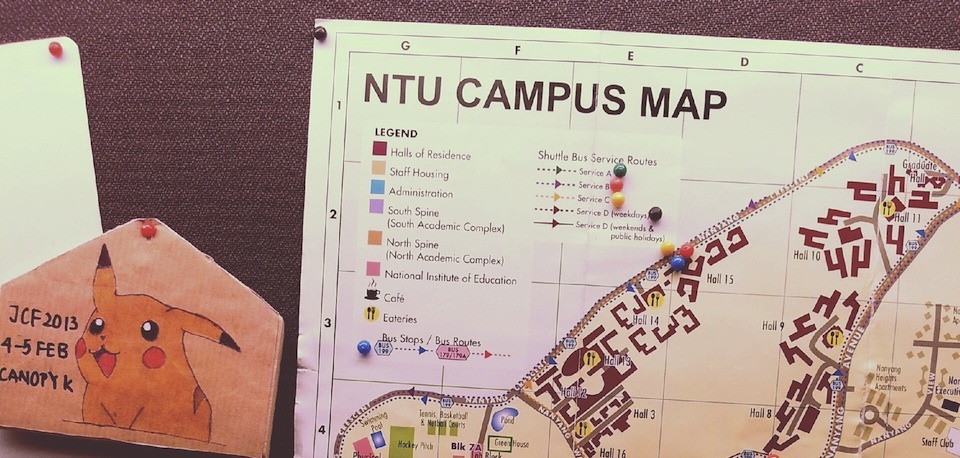
Map

You see—being exchange students in the 2nd term, my friends and I have to struggle with at least four different challenges: 1) everyone has their cliques-from-last-semester already, 2) even when it’s possible, establishing deep connections would only hurt because you know you’re gonna leave them after a couple of months, 3) (mini) cultural shocks every once in a while—including how people here don’t really speak English, and 4) your peers patronize you because you’re just an exchange student. Oh plus, (this one’s exclusive to weird social science students who hang out with folks from engineering): 5) nobody really cares about philosophy and politics—one of them actually said that I ‘wasted’ my time taking them as an academic focus.

That, my friend, was more than enough to strand me in an isolated island, let me double-observe my surroundings, and give me the privilege to greet that old, frightened little girl inside me, with whom I decided the area where I will stay throughout my temporary journey.

Again, these are not guiding points to ‘settle down in a new environment‘, but more like a sneak-peak of what it would be like to discover that usually inaudible genuine voice inside your head. Something today’s sophisticated society calls as ‘self‘ (note that I prefer to deliberately use a singular form of ‘self’, appreciating each’s distinct uniqueness).

1. Give Up Your Identity

One of the reasons why it becomes harder for us to listen and understand our ‘self’ nowadays is because there are so many external noises coming from people’s perceptions and expectations towards our being. These dins are loud—very loud in fact, so loud that you cannot really hear any sound produced beneath them, concealed by layers of social consciousness.

Back when I was ‘Afu’, for example, I wore this heavy rucksack of ‘what people want me to be’ that sometimes I automatically chose an option based on the prejudices I assumed existed and denied option B, C, or D when, come to think of it, they actually made more sense.

The first step to self-discovery is then to enter the room of complete silence. Shut all these rackets off by starting new. Let that ugly rucksack go. Be selfless. Don’t bother getting a new rucksack by bragging to your new friends about what you did, loved, or hated. You used to tell everyone you’re an introverted avid reader? Put down that ideal self-image for a while. Instead, just be present, participate, and give spontaneous responses. It would make you feel alive.

Constructivists always say that we’re a blank slate after all.

2. Experiment with Different Personalities

Now that you’re practically nobody, it wouldn’t hurt to experiment with different personalities and see which one appears more natural to you. Indeed, inventing a completely new persona requires imagination and ability to improvise, but it’s fun especially when you get used to it after a while. Of course: do not fake anything. The point is to experiment, not to play a drama or play a phony role just to pointlessly impress new friends.

Put on some new types of clothes—skirts if you’re too comfortable with pants, and T-shirts to replace your collection of laced tops. Do some sports, take yoga classes, visit a museum—experience. Hang out with the kind of people you wouldn’t have otherwise (in my case: engineers completely unaware of Indonesia’s current political situation). Pretend not, however. If you’re dead sure that you hate partying all night, why waste your time doing it?

What I’m saying is, maybe the person you have been is not the person you’re supposed to be. You might be missing out some great things because you stay in that box of ‘who I am’, defined excessively by your family, or worse, your ego.
So fear not—try things out.

3. Listen to the New Voices

Now that you have the access to a complete database of possible personae on the table, your next mission would be to have an open mind and listen to the new voices that resonate consequently. They might be very subtle, at first—like a muffled whisper; but trust me: as soon as you’re aware of its existence, you become more and more sensitive. In the end of the day, you would be able to listen to even the most quiet sound.

I’m not merely talking about the voices inside our head, by the way. Of course being a stranger in a new place will provide you with this chunk of time to contemplate and listen to the ‘self’ that talks back to us at times (these things aren’t for you—oh wait, look, I knew eating alone was fun), but making new friends also means listening to new, honest opinions (that aren’t ad hominem).

I myself have been spending the week with a bunch of male engineering students (mostly Agi and Iip‘s friends-slash-flatmates), none of which cared about ‘democracy in the third world’ or other immaterial (thus irrelevant) concepts. Although I really enjoyed being around them, most of the time I had to be the clueless-when-it-comes-to-science Penny who, clearly, didn’t understand what the guys were talking about (especially when it comes to computer codes, DotA, or Yu-Gi-Oh cards). To my surprise, these people actually gave me new insights about who I really am and what I really like doing.

(FYI it doesn’t involve engines nor laboratories. Obviously. LOL.)

***

The first nine days had been new and strange in a good way. I wonder what the city-state (of torture to grammar nazis) would bring me in the next months.

I’m not sure if I really made a point here, but surely anyone who made that ‘get lost to find yourself‘ line—a psychologist, I believe—put it forth better. Cheers.

P.S. Education-wise, Singapore doesn’t seem to favor the Socratic, western way of stimulating insights through questions. Instead, they go with the Confucius, eastern way of internalizing values through repetitions. Which is interesting,