In a planet where opinions are openly contested—although not necessarily valued—everyone appears to disagree upon everything: environmentalists refuse the expansion of industry, liberalists oppose regulated markets, and technocrats always opt for continuous progress above other options. Deep inside, these people have an ideal picture about the future they want to live in and, despite the apparent dissimilarities, all of them are united by a commitment to the quest of accomplishing their visions.
I, too, have my own aspiration about how a perfect world should be.
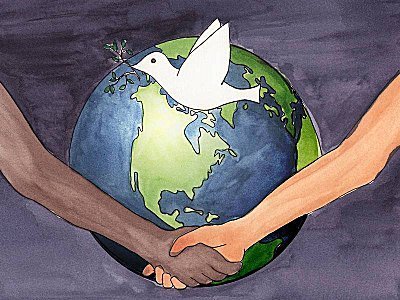
For one thing, power tends to corrupt. The idea of social contract where abundant control is ‘voluntarily’ given by the society to a group of chosen individuals, therefore, has its intrinsic gravitation towards fraudulence. In many parts of the planet, this nature materializes in the form of strong soldiers killing innocent people for an invisible cause called ‘nationalism’, terrible misconduct use of budget that actually belongs to poor people, as well as limited freedom of speech over various means, justified merely by the paranoia of government officials. The most powerful ones ironically claim that they strive towards obtaining international peace when the only tools they use are guns and grenades.
The good news is, these conditions are not given; they are rather the products of a concept invented by the emperors and kings of Europe almost four centuries ago. Like any other invention, I believe that ‘nation-state’ also has its expiration date. Today, this process is further accelerated by globalization and technology, both of which have been escorting the global civil society to be stronger than ever. Just in the last few decades, transnational solidarity and tolerance have proven itself to be so powerful it can change the decisions taken by world leaders.
It is therefore possible that in less than a hundred years, states’ dominance will be replaced by a network of restless efforts and voices of the people. When the time comes, we might also overhaul the current system and recreate the foundation of this planet—because human beings deserve a better future. A completely different world from what we have now.
In that world, the only spoken language will be the language of unity. The disappearance of the word ‘nationality’ will be accompanied by the extinction of ‘gender’, ‘race’, ‘class’, as well as ‘ethnicity’. All of them will no longer be printed in dictionaries of any tongue, replaced by vocabularies of equality and justice. As the consequence, the level of misunderstandings between humans will greatly decrease, along with the ridiculous hatred among them.
In that world, the only visa required will be your birth certificate. Every newborn baby will be a citizen of the world, and one day he/she will settle down in a territory that needs him/her the most, regardless their blood relation. No one will be able to prohibit any individual from travelling and experiencing the journey of their life for one-sided political grounds.
In that world, the only valid money will be in the currency of love. When power is no longer a transactional commodity, it should be distributed equally to the people who need it. ‘Empowerment’ will become the main jargon of the next generation’s civilization, as they realize that leaving behind marginalized groups will equal the beginning of their own devastating loss. The economy will not be run under forced egalitarianism, but rather constructed upon the essential awareness that—at the very least—one shall not become a burden to the others.
In that world, the only prevailing religion will be humanity. Yes, everyone will still hold to their faith in different gods and rituals, but they all perceive one another as one big family. While safeguarding an even richer diversity of beliefs, conscience will speak louder than man-interpreted sacred texts, and mortals will be able to value life more than ever before. Wars will be kept in museums forever, visited by people only to remind themselves about the horrendous history mankind once had and shall never be repeated.
In that world, there will be no states. There are only I, you, and billions of people who give up the identity that our governments and grandparents once dictated us to have. There will only be a peaceful planet filled with men and women who regard differences as something to be grateful of, and impartial justice as their non-negotiable principle.
[P.S. This essay was submitted to the UNESCO-GOI Peace International Essay Contest for Young People and surprisingly got me the 3rd Prize, alongside with other wonderful writers from across the globe.]
 Afu's Conundrum Journal