I’ve always had a complicated relationship with Indonesia, but not like this (Nesia, 80 years later)

In 1945, Nesia was born—birthed prematurely, some might say, out of youthful impatience and necessity. The welcoming ceremony was rather modest, held on the grounds of her father’s home on Pegangsaan Timur (now Menteng), with a few hundred present.

Nesia had many fathers hailing from different islands, she did, and they all had big dreams for her—albeit not exactly shared ones. Some were more nationalist while others were Islamist, some believed good decisions came from long deliberations, while others were more passionately intuitive. Some wanted a negara federal, while others believed that this country was destined to be a negara kesatuan. In the end, Soekarno and Hatta were given main custody (instead of Sjahrir who had no chance, or Wahid Hasyim, or Kasman Singodimedjo, or Ki Bagus Hadikusumo) because they were the epitome of ‘balance’: one magnetic Javanese orator who charmed the people, and the other a calm Sumatran thinker who was fluent with the elites.

Nesia’s other fathers were able to set their differences aside for a minute, because they understood something bigger, something earth-moving, was happening: they were building a whole nation from the ground up. One that had so much potential, one that would fight for humanity in every corner of the world, one that would bring colonialism down—in any shape or form. One that would be so just, she would make sure the god-given natural bounties in her land and sea benefited everyone.

They even put these dreams down in Nesia’s birth certificate.

Twenty years in, and Nesia hit her first stumbling block: a certain type of ‘cancer’ that she needed to get rid of—her new father Soeharto claimed. For a couple of years, she fought her own body so hard that she inadvertently removed not just the ‘bad cells’, but her best ones too—exiled abroad or ended in situ—these must have been parts of her brain that kept her moral compass and intellect, because for the next decades, it deeply affected the way she thought about the world.

In fact, many things happened in the following 32 years, and Nesia wasn’t sure if she was living her forefathers’ dreams anymore. She was trained to not think and to be afraid of her father; it was best to agree with whatever he said, if she wanted to stay alive. Sure, he managed to build, many still claimed he was the best builder-father Nesia ever had. But at what price? Nesia started finding her memories fuzzy, and ended up relying a lot on what her father said happened. She could swear that sometimes her father would tell her the opposite of what was true, but she learned the hard way that it was best to stay silent.

When her longest-reigning father left in 1998, she had to admit she was a little lost.

All of a sudden, her international friends surrounded her, swarming like bees, telling her what to do as she finally found her freedom. Fix your financial system, they said, take some loans to build your house, others insisted. It felt nice, being able to listen to anyone but her father—albeit her head felt loud for the first time in a long, long while.

Unfortunately, nobody reminded her about the most important piece of all: she needed to overhaul her political system. Her fathers’ friends were still around, trying to hold on to whatever pieces remained, no matter how scattered. Had she had a do-over, she would have thought through the role of parties (not the kind with music), about conflicts of interest, about cleaning her council from those with her fathers’ agenda.

She also would’ve invested a lot in reforming how she educates herself. She would’ve spent years relearning what it means to be a democracy, rebuilding her agency again as a great nation that could determine her own future, instead of being manipulated by more power-hungry fathers in the future.

Despite avoiding this difficult task at hand, things were looking good at first.

Major economic reforms took place, she even managed to introduce a commission dedicated to eradicating corruption (that’s huge!), and decentralized the hell out of her autonomy. She grew fast, and healthy too. Yes, there were a couple of hiccups in the form of financial crises, but overall she managed.

The year 2014 she reached a whole new milestone: she elected a father who didn’t come from power at all. He was supposed to be the man of the people. And boy, did Nesia’s new father build infrastructure—ambitious projects all around the country, ones that were supposed to lower logistical costs and help her grow even faster.

But all while this was happening, putting the education reform agenda in the backburner came back to bite her. She was clearly running out of time, and the window to prepare a truly great nation—one that think for itself, that was driven by the core values of humanity and justice, that cared about one another—the nation that her first fathers dreamed of, was closing.

Her people were petty, apolitical, and quick to judge one another. And they were trained to be shortcut takers, to be preman (pre-man a.k.a. manchild) who constantly looked for loopholes. They would exchange their votes for a little Rupiah, because the system forced them to give up on their true power—they failed to remember that they could flip those seats if they chose to.

The youth were distracted all the time: they were fed with content and consumerism, both taking most of their remaining mindspace. They were made to love the country enough to pay their taxes, but not too much that they would disturbed seeing those exploiting Nesia—disturbed enough to all go to the streets, angry enough to bring any unjust fathers down.

The most righteous amongst them, however, were divided. The fighters, those who were supposed to be more united than anyone, focused so much on their 10% of differences and abandoned the 90% shared mission that they had. They pointed fingers at one another, claiming the other was not righteous enough (because they didn’t put their lives at stake), for example. All while the evil ones continued scheming with one another, even when they only had 10% of their agenda in common, generously giving praises left and right, even to those without any ethical backbones left.

Her people were made to feel intimidated by brains, and trained to love the pretty, rich, and popular. They were turned into bullies who picked on people for the smallest of things, those who said something wrong that one time. They were told that loving Nesia was about speaking her language, or exclusively living in the country, instead of what they use any language for—no matter where they were. How misguided, given that Nesia’s forefathers all used Dutch as they started dreaming about independence.

Today is Nesia’s 80th birthday, and she has never felt more astray from where she was supposed to be. In three years, it will have been 100 years since 1928, the year her forefathers dared to start dreaming about giving birth to her, when her forefathers chose to be one nation instead of several, because she was worth fighting for.

Is Nesia worth loving still?
Were her fathers’ dreams still alive?

Against my better judgment, I kept failing to let her go. Every time I found a reason to, I kept meeting incredible human beings who wore their big heart on their white sleeve and made staying worthwhile. Those who didn’t even flinch when (any of) Nesia’s father(s) tried to put fear in them.

If fate could take extreme turns and courses shifted in the past 80 years, she could very much do a lot in the next 80. Nesia just needs a bunch of naive believers, much like her fathers did at the beginning of this journey of nation building. Those who looked around, and questioned the way things were run, those who tried to do something no matter how trivial and small, those who kept the fire alive for a little while.

Those who would gladly join the fight, until it (hopefully) sparked something, even decades later, even when they may not live to see Nesia’s glory.

***

https://www.youtube.com/watch?v=GgxPJRN_LVI

Dear Theodosia, what to say to you?
You have my eyes, you have your mother’s name
When you came into the world, you cried
And it broke my heart

I’m dedicating every day to you
Domestic life was never quite my style
When you smile, you knock me out, I fall apart
And to thought I was so smart

You will come of age with our young nation
We’ll bleed and fight for you
We’ll make it right for you

If we lay a strong enough foundation
We’ll pass it on to you, we’ll give the world to you
And you’ll blow us all away
Someday, someday
Yeah, you’ll blow us all away
Someday, someday
Oh, Philip, when you smile I am undone
My son, look at my son
Pride is not the word I’m looking for
There is so much more inside me now

Oh, Philip, you outshine the morning sun, my son
When you smile, I fall apart
And I thought I was so smart

My father wasn’t around (my father wasn’t around)
I swear that I’ll be around for you
I’ll do whatever it takes (I’ll make a million mistakes)
I’ll make the world safe and sound for you

Will come of age with our young nation
We’ll bleed and fight for you
We’ll make it right for you

If we lay a strong enough foundation
We’ll pass it on to you, we’ll give the world to you
And you’ll blow us all away
Someday, someday

Yeah, you’ll blow us all away
Someday, someday
I’m past anger, just sad (keeping up with the Moelyonos)

“Are you coming with me to the protest?”
“No, I’m gonna stay and work, holding the economy together,” said my husband half-jokingly, on the fateful August 22nd, the day DPR was going to ratify the expedited—hence problematic—revision of the Pilkada law.*

I rolled my eyes (lovingly), then hugged and kissed him good bye. Ten years ago we would’ve switched positions—his old friends from college days would’ve expected that he’d not only join, but also help organize (si paling anak kastrat). On the MRT, I figured people turned their back today for a few very different reasons:

The first one, the old fashioned, is pure naïveté—the oh-so-blissful ignorance. Being shielded away from the throbbing anger and fear from actually understanding what’s going on. Lacking the historical references to realize how worrying it is to have a coalition almost without opposition. Not being bothered by incompetent candidates being given the highway to run for office because they are related to power. Immovable by the fact that we may have catastrophic public policy made by wrongly motivated decision makers. There will come a time, I hope, when knowledge touches them and turn everything around.

The second one, however, runs deeper—it’s that of disillusionment. You know exactly how critical the situation is, but you’ve been let down one too many times by your own expectations. Having faith in a leader just to be disappointed again and again. Wondering if it were you (???) or them (definitely them). Having tried, given it all your might, just to find yourself beaten to the ground at the end. Feeling a lot like banging your head against a wall—wishing it breaks before your head does. Another day, another ‘good leader’ gets corrupted by the system. Waiting for a different game altogether, some kind of disruption, a new window for change.

But mine is neither, it’s a completely different monster altogether. I cannot—as I could have 10 years ago—say with a straight face that I care. It is very possible that I don’t anymore. It is not that I have been let down ‘by the system’ (I’m smart enough to manage my expectations since day one), but by the very people I was trying to—for lack of better word—help. The way that we self sabotage into our own doom, the few times that people brought me down. If I’m being honest, with my privilege I probably would have survived this impending regime even without doing anything.

And yet I moved, still.

Against reason, I find myself weeping together with the other Kamisan protesters in front of the Presidential Palace that late afternoon, singing, “Pasti menang, harus menang… Rakyat berjuang pasti menang.” as the sun was poetically setting behind our backs.

Perhaps it was simply out of a muscle memory. I do not know, could not, respond in any other way. When I feel helpless, I show up. When I feel disgusted by injustice, I speak up. When there is work to be done, I make a to do list. Not always through grand gestures, but just enough to make me feel less in despair and sleep better at night.

Perhaps it was because I wasn’t alone. Between the Think Policy team and Bijak Demokrasi community, I had endless supply of energy and camaraderie. It simply felt unnatural to stand still. Literally everyone is taking their part: standing in front of a crowd, telling their stories, spreading awareness. Maybe that’s why they call it a movement—it was supposed to compel you to move, making it impossible to do otherwise.

Perhaps we have reached a new boiling point. We have seen corrupt leaders before, but not like this. People protesting for the first time in their lives, public figures too angry not to join the crowd. I don’t remember it being like this before. But we may lose this momentum— it is imperative that we do not lose sight of the long horizon.

What is the bigger picture?

Seperti cinta, demokrasi harus diusahakan. It’s a journey of making democracy work. I too, thought that it was good enough that we get to vote. But no, there is such thing as a quality democracy and we are far from it. Ensuring everyone’s participation is hard work. Doing civic and political education properly is hard work. Reforming the political parties? Still seems impossible without a black swan event.

It seems like a losing game, but tell me, is there any other way to be than to try?

We deserve better.

Because the Freedom to Think Is What Makes a Human Human

(More boringly known as: “A Personal Musing on Who Should Be
Indonesia’s Next President”.)

As the old car we rented passed by a local school in Putussibau yesterday, my mind wandered back to the time I was still an elementary student. Compared to how ‘she’ works today (yes, my brain is a female), I was a very different girl back then. For starters, I never really questioned regulations, I enjoyed abiding them, and being critical was not really a concept I could grasp. Growing up is funny, you see: we are physically still the same person—seeing with the same eyes and talking with the same mouth—but inside, we are almost a different person every day. I could vividly imagine myself from five, ten years ago in loud disagreement with the present me.

Anyway, there are some fragments of memory I would like to share about being in a white-and-red uniform in the last two years of New Order era (and four more during the early Reformation period).

I remembered wearing my favorite hairband (which was pink); I remembered the great sensation of knowing that you could add and subtract numbers (I mean how awesome is that); and I remembered impatiently waiting to learn new things every morning. But on top of them all: I remembered being introduced to rules. I remembered recognizing ‘right’ from ‘wrong’.

Parlemen Muda-6571

They say kids are like sponges: they absorb knowledge very quickly, and they memorize what their parents say on the fly. This, I now understand, is the basic idea that Soeharto’s regime utilized to control the way young Indonesians behaved—through feeding us doctrines of what is okay and not okay via education.

Being under the authorities’ influence, my brain automatically created a simple binary system that registered deeds into ‘GOOD’ and ‘NO GOOD’ shelves. Submitting homework on time, for example, is an absolute ‘GOOD’. Not wearing the red cap on Mondays is ‘NO GOOD’, just like being late is. The flag should not touch the floor (now I find this idea very ridiculous) and the teacher is always right.

This library of information continued storing data as I grow up (adding things like ‘drinking alcohol’ to the ‘NO GOOD’ list as well as ‘being extremely active in extracurricular activities’ to the ‘GOOD’ list—not sure where I got that from LOL).
And it evolved to the extent I hated the Communist Party with all my heart. Our history books were pre-cooked with judgments, you see, it was written in a way that made us hate certain actors (including the Dutch and Japanese—the ‘penjajah’) while overselling the patriotism of our military force.

This over-controlled sphere of opinion-producing and significant absence of space for debates and criticism (linear curriculum with multiple choice tests FTW—NOT) turned most Indonesians (including yours truly at that time) into self-righteous, narrow-minded, judgmental pricks.

Today, more than a decade later, I know better.
I know that there is no such thing as an absolute right and absolute wrong.

I would tell myself from 17 years ago that sometimes not submitting homework on time is good when you have to take care of your mother, and I would break the news to my teenage self that people have life priorities, she would have to accept that. You see, my stupid young self: 1) laws were made by human—even the ones God created are interpreted by people with flaws, 2) we could criticize and challenge any of them when it’s not working, and 3) we could also create one of our own.

My college friends call this epiphany as being ‘liberated’—I call it a blessing. It’s a blessing to be fully aware that we are allowed to think; that we could question any tradition, we are encouraged to doubt the regulars, and we are free to investigate fallacies. Most fundamentally, I appreciate the rewarding pleasure of being able to disagree and produce our own, independent thoughts. (Read 1984/Anthem/A Brave New World for more of this.)

Having gone this far, of course, I would not allow the slightest possibility of having an authoritarian regime that will limit our newly-acquired freedom to think (let alone of speech) again. I won’t give a room for a new New Order.

Now this consciousness development relates a lot to whom I’m voting for on July 9th.

If you’ve been reading my tweets lately, you would’ve guessed already that I’m rooting for Jokowi. Well I am, you see, but unlike the people with half-red avatars who’ve been actively supporting the incumbent governor of Jakarta, my initial reasoning process is very straightforward. I simply don’t want to be governed by people who haven’t undergone the same mind-opening process, who think that democracy is merely a means, that freedom of speech is secondary in comparison to access to welfare.

I would rather avoid having a self-righteous president who are subsequently backed by a group of narrow-minded politicians in his cabinet.

The evidence of this allegation toward Prabowo is all over the place:

#1 Whenever asked about his human rights record, Prabowo always passes the ball to his military bosses (‘tanya atasan saya’). This signals two things: 1) he could not see the underlying problem of this ‘order’ from the first place (needs some text book to grasp the concept of human rights, perhaps?) such that he wasn’t able to feel guilty or at all apologetic to concerned families, 2) he still thinks like a soldier, because certainly a leader would be brave enough to take a bullet and volunteer to go to the court and let the bar decides.

#2 ‘Self-righteous’ is the second adjective that came into my mind to label the parties and organizations supporting him, after—of course—’hypocritical’. I mean, how else would you call PKS (meat corruption), PPP (Surya Dharma Ali case), Ical (and his unfinished Lapindo business), as well as PAN (Amien’s inconsistent statement). Not to mention FPI, FPR, and Pemuda Pancasila boys who are far from valuing human beings, let alone our rights to everything else.

#3 His party specifically mentioned about ‘membuat jera agama yang menyimpang, which is practically rising a big fat board with ‘I AM VERY NARROW-MINDED’ in capital letters on it. I could really go on with this, but there isn’t really much point in doing so.

But again, if my problem is with Prabowo, why bother voting for Jokowi at all? Why don’t I just, let’s say, go Golput?

Well honestly, I had my hesitations (cherishing the freedom to think, remember?), but then I talked to a number of people, read several articles, and eventually arrived to the conclusion that Jokowi deserves my vote. Just to make it an apple-to-apple comparison: Jokowi does value open-mindedness, and this is reflected from how Solo and the first several years of Jakarta performed under his wings. Instead of going with the conventional methods of running things, he made notable breakthroughs here and there. Innovation as well as the ability to think beyond what has been done for years.

Now because we all attach importance to the freedom to think, I would not try to convince those who doubt Jokowi’s control over Megawati’s hidden intentions. However, so far he has demonstrated:

#1 Merit, merit, merit—I’ve been telling people how I am all for meritocracy.
Jokowi is the only presidential candidate with almost 10 years of experience (and proven achievements) leading different governmental levels, and there goes my first checklist. If there’s anything you should doubt, it’s the ability of a fired military personnel to run a cross-level and cross-sectoral ministries that sometimes need out-of-the-box debottlenecking measures.

#2 He is surrounded by open-minded people—Anies Baswedan is more than enough to prove this point. This also means that the people around him does not seek for power (they are smart enough to know that ministerial positions are non-negotiable). On top of this, his work has also inspired his own party and its chairlady to actually be open-minded enough to allow someone from outside the party’s leadership to run as president.

#3 He has a lot more to offer and a lot less moral baggages to deal with—despite having Jusuf Kalla as his running mate (the man who introduced Ujian Nasional), Jokowi actually promised to erase the national examination for good if he gets elected. This is a very bold offer, of course, and at the same time also shows his ability to negotiate and compromise with Kalla. At the same time, despite generic, he also has many ideas to bring to the table in his white book (although debatably this was prepared by his team, which presidential candidate doesn’t?).

Because to me, the freedom to think is what makes a human human. Because the freedom to think is the start of every great civilization in the world. In this light, I will vote for Jokowi because I believe he would do everything he could to protect our freedom to think—to disagree, and to criticize the government. He would work for us, and that’s enough.

[Btw, this probably isn’t the first article you’re reading on June’s heated presidential race, and certainly isn’t the best either. I call it a ‘musing’ because clearly it’s circling around without making any sharp point, and ‘personal’ because d’oh.

Thanks for making it this far, though.]

Democracy: The Story of a Spoiled Child

“Don’t (write), unless being still would drive you to madness,” says Charles Bukowski.

Having been extensively exposed to our domestic politics lately—mostly through talks with Andika or works related to Parlemen Muda Indonesia—I couldn’t help but to spend a significant amount of time revisiting my idealism of how a government should work, and consequently grows a strong urge to write this very essay.

I’ll start with a big question mark: is democracy the best power system in the world? Seeing how a majority of countries today decided to embrace it, most people would probably find the inquiry not very challenging. Yes, they would say, a type of government whose power comes directly from the people being ruled must be the fairest deal available. Because really, who would want to be ruled by a blood-appointed individual (like in classic monarchy) or an elite group of privileged intellectuals (or what Aristotle called as oligarchy)? Well, let’s talk about that a little bit more.

Untitled
[Picture courtesy of House of Infographics and AyoVote, two awesome youth-driven initiatives.]

Let us first establish what we mean by ‘best’—I would propose the following: 1) rational with accountable rulings and decisions, 2) effective in ensuring wealth and prosperity of many, and 3) less prone to tendency to corrupt. From a historical point of view alone, one could argue that many empires, dynasties, as well as other similar non-democratic regimes have successfully achieved these three steps of being a ‘successful government’ although not entirely flawless. But so isn’t democracy.

At the end of the day, perhaps the main debate should sit at the principles where they were built upon; it is not a race of achievements, but more about the basic notion of justice and ensuring a playground that enables us to protect it.

So, what’s with the spoiled child, again? Well…

I. He Was Born Quite a Long While Ago (As a Different Breed)

In the city-state of Athens, around 507-508 B.C.E. It means that mankind has learned about it for almost 2.600 years and yet is still clueless about how to make it truly work. A good reason to this is likely the fact that what we know today as ‘democracy’ was not exactly what Cleisthenes referred to when he first introduced this back then. Despite having a similar property of executive-legislative-judicial branches like the now-democracy, the then-democracy had two largely contrast features:

  • Government administrative and judicial offices stood upon random selection of ordinary citizens
  • Legislative assembly consisted of all Athenian citizens

By ‘all’ I really mean every single citizen living in the big A. Although, do not forget that numbers also matter here. Athens had only 30.000 official citizens (women, slaves, foreigners, and youth under 20 excluded) who arguably had equal access to education and assets. This made it possible for them to practice democracy in its most primitive, naked meaning: power (thus decisions and regulations)
from the people, for the people.

Now that the statistics became unbearable (I’m not sure if we can find a room or field large enough as a legislative assmbly to hold up all 200 millions of Indonesians), however, we had to learn the concept of representation. We had to accept that a smaller group of people (560 is pretty small, even compared to how the Greek did it) speak for us in the parliament, hoping that they really know what we want.

On top of that unfortunate reality, the inevitably growing disparity of knowledge and/or wealth among millions of us also made democracy a tricky business: it enables men possessing more money or intelligence to claim for power by buying/manipulating votes from the poor and/or the stupid. I cannot agree more when Will McAvoy said that a well-informed society (and a prosperous one, an economist would add), is prerequisite to a healthy democracy.

II. His Friends Enjoyed Playing Different Kinds of Games

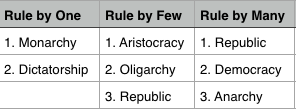
Newsflash: democracy is not the oldest form of government. It is mainly patriarchal monarchy, traced back to the days where the alpha-males led their tribal groups. The oldest sons usually had it coming that they will rule after their fathers ceased, and therefore had longer time to get himself prepared for the throne. In fact, based on the numbers of rulers alone, democracy has 7 good companies:

Screen Shot 2013-11-03 at 20.49.51

And by no means to surprise you, I’m actually a fan of oligarchy (rule by a group of best people—sometimes confused with ‘aristocracy’, never quite understand the difference between them)—albeit I would like to emphasize that meritocracy (whose tenet is basically ‘individuals with merit should hold power’) shall be the very core of it. A month ago Daniel A. Bell and Chenyang Li wrote an insightful essay about Compassionate Meritocracy which caught my utmost attention, defending Singapore’s political system (or what the West often labels as ‘pseudo-democracy’) which advocates ‘an institutionalization of mechanisms aimed at selecting the candidates who were best qualified to lead—even if doing so meant imposing constraints on the democratic process’.

It is exactly this that makes me reluctant to completely believe in democracy: people stop debating on the strategies to choose the best leaders because it hurts the universality of democracy. Since “democracy demands only that the people select their leaders, it is completely up to voters to judge candidates’ merits“. I mean despite forcing candidates to spend a big portion of wealth in producing banners, posters, and all kinds of expensive advertisements, democracy still does not guarantee that we get the best possible individual to lead or legislate for our country.

If anything, democracy is simply ineffective.

III. Many Good Rumours About Him, Though

Should these flaws stop us from sticking ourselves to democracy? I’d love to say otherwise but the answer is no. Yes, democracy is ineffective and there are many loopholes in it, but it also halts people from going to war (pure monarchy does induce possible hatred among royal family members and attempts of power acquisition from other houses—yes, by the way, I watch Game of Thrones). Additionally, democracy creates disincentives for governments to go to war with one another (since the people will ask them to stop). Democracy could’ve done a lot better had we fixed its derivatives.

I use the word ‘spoiled child’ to describe democracy because people have been taking it a little too much for granted. You can use it as a magic word in any kinds of legal plead or political speechpeople are likely to respect you if you respect democracy. Additionally, a ‘democratic process’ has an ameliorative sense by definition, but the truth is, today’s Indonesia is not the best home for our spoiled child to grow, and here are some quick facts for us to think about:

  • The statistics predict that from the total 55.000.000 of our below 30 voters, 50% of them are very likely to not give their vote to any party (golput).
  • We still have a high number of people living in property with low access to education and complete information about political candidates (both executive and legislative), disabling them to make the best possible decisions.

They say that there is an irreplaceable fun and great learning from making mistakes—well, I just hope that our fun and learning process is over. I hope that 2014 is a game-changing year for Indonesia’s democracy. I mean, at some point, the child has to grow up, doesn’t he?

What It Really Takes (for Indonesia to Reemerge as the Third World Leader)

[An essay I submitted to the G20 Youth Indonesia selection committee.]

Indonesians are trapped in historical romanticism for a reason: this archipelagic country was once indeed a great nation who stood up against post-colonialism inequality while promoting cooperation in order to accelerate the accomplishment of post-World War II development agendas. The establishment of Association of Southeast Asian Nations, the success of Bandung Conference and consequentially Non- Aligned Movement, as well as Indonesia’s victory over the Netherlands in the case of West Papua; these three cases are enough evidence to demonstrate Indonesia’s outstanding performance back then. Not only were we the pioneer of great initiatives in the region, Indonesia was also respected as one of the game- makers during the Cold War era—hence validating the claim I made in the beginning of this essay.

Tes_copy

Having undergone over 67 years as an independent republic, however, it is essential for us to stop glorifying the past and question our current standing: where are we right now? Have we lived the pride our Founding Fathers had about a harmoniously prosperous people they dreamt of? If not, what went wrong and—more importantly—how could we fix them? These inquiries are very pivotal drivers for today’s young generation lest this nation seeks to move on from exalting the past and start being proud Indonesians. Deep down, I always believe that if we manage to unleash all of Indonesia’s potentials, this country will not only reemergence as the leader of the Third World: we can be one of world’s greatest state-actors both in economic and political sectors. The following paragraphs will explicate further upon the foundational strategy that is deemed essential to achieve such an ambitious notion—each of which covers both national and international aspect of the policy.

I. Open Government: Bureaucratic Reform as the Backbone of Change

Blame the game, never the players. I believe that it is not impossible to change the behavior of individuals as long as an effective system is in place. All the issues coming from Indonesia’s bureaucrats, thenceforth, should also be dealt using this intelligent postulation: that the rules and regulations need to be frequently monitored and evaluated more than the countless problems themselves. In other words, the leaders of this country should utilize a helicopter view lest they wish to mend the republic holistically. So before Indonesia continues with big ideas on international standing and foreign policy recommendations, the issue of open government (i.e. transparency and accountability) needs to be addressed immediately— both as a domestic matter and a universal currency.

The story of Indonesia’s struggle in improving its bureaucracy has begun long before the 1st Open Government Partnership meeting was held in New York, 2011. But taking co-chairmanship with the United Kingdom this year, Indonesia has made a global commitment to enhance its checks and balances mechanism paralleled with national endeavors to increase society’s participation in the process. The year 2011, 2012, and 2013 are stated by the official Secretariat (under the President’s Delivery Unit of Development Monitoring and Oversight) respectively as the ‘commencement phase’, ‘breakthrough and innovation phase’ as well as the ‘expansion and intensification of public participation phase’. The year 2014, therefore, is a critical period that will determine the success of Open Government Indonesia’s four- year national roadmap as well as its bargaining position internationally.

If I were the next president of this republic, I will firstly ensure the continuation of this initiative. Domestically, a more open government will not only effectuate a better coordination as well as decision- making process amongst the cabinet and ministries I lead, but further it will also enhance the quality of public service units, eradicate corruption, restore society’s trust in the government and, in return, build stronger political participation. Internationally, Indonesia will gain more respect because, despite being a developing country, it dares to prove its consistency in promoting a more open government that adjusts with the advance of technology and innovation—which is still a difficult mission
for Third World countries.

II. The Archipelago Economy: (Agricultural) Growth for All

Having repaired the government’s home-performance through bureaucratic reform, my next focus would go to our economic growth. Above everything, we need to realize that Indonesia is one of a few countries that are bestowed with rich natural resources. To list a few, Indonesia is: 1) world’s largest producer and exporter of palm oil, 2) second-largest exporter of coal, 3) second-largest producer of cocoa and tin with 4) fourth- and seventh- largest reserves of nickel and bauxite. November 2012, however, marked a historical wave in the course of Indonesia’s economic performance, when the country’s top 1.500 leaders gathered in a visionary meeting to discuss how Indonesia can boost its potentials even further. In this meeting, a report on The Archipelago Economy: Unleashing Indonesia’s Potential was presented and the findings were rather a shocking one: Indonesia was predicted to surpass Germany and the United Kingdom as world’s 7th largest economy by 2030.The analysis highlighted how it was pivotal to safeguard stability while promoting diversification of economy in order to invite more investors as one of the key factors in the country’s overall development. A thorough and meticulous management is then mandatory in order to deal with this once-in-a-century economic transformation. As the leader of the country, I would ensure that all of the participating parties in the national meeting to harmonize and accustom their respective institutions to take part in this astonishingly stimulating vision.

Among others, my priority would be set upon increasing the country’s national productivity in agriculture and fisheries. One of my most elementary reasons will be the apparent rise in the number of middle-class consumers in the emerging markets such as India and China. Domestically, the increased demand is predicted to take place simultaneously with giant migration of countryside citizens to the cities. According to the report, to meet domestic demand alone, Indonesia’s farms will need to increase productivity by 60%—making it imperative for the government to anticipate and ensure significant improvements in agriculture and fisheries sector. All of these efforts should aim at well-distributed growth throughout the archipelago, accompanied by adequate skill-based
investment in our youngsters.

III. Take Big Jargons to the Extra Miles: Reestablishing
Leadership In the Region

Traces of Soekarno’s brilliant discourse building such as the dichotomy between NEFO (New Emerging Forces) and OLDEFO (
Old Established Forces) in the Cold War era seemed to have also inspired today’s foreign policy. After Yudhoyono’s infamous line ‘a thousand friends, zero enemy’, the MoFA continued the legacy by bringing up the so-called ‘dynamic equilibrium’ to the table of our regional negotiations. Last year, chairing ASEAN, Indonesia also introduced the vision of ‘ASEAN community in a global community of nations’. These three jargons should, I wholeheartedly believe, be utilized to further empower Indonesia’s role in the global arena. Beyond this, Indonesia needs to bring up the equivalently important discourse of sustainability and human security as the main development agendas post-2015. Hundreds of years of civilization have taught me one thing: that the power of words is often undermined—as long as the country’s leaders commit to the discourses they initiated, it is not impossible that the international community would once again pay respect to our country’s determination and acknowledge our leadership in regards.

After all, the year 2014 should not only become a year of ‘democratic festivities’ where millions of Indonesian citizens will celebrate democracy by using their voting rights, but also a decisive period that will determine whether or not this country can unleash its predicted potentials. Having elaborated three of the most basic—not necessarily huge, but profound—policies that need to be catered in welcoming a greater development for the country, I would like to also emphasize the important role of youth as the upcoming decision-makers, entrepreneurs, as well as engineers of the country: the government needs to invest more in capacity building programs and educative projects. Shall these foundational aspects be successfully accomplished, I am more than confident that the nation can finally move on from their pseudo-pride of historical romanticism—and cherish the real thrill and honor of being an Indonesian.

Footnotes:

[1] ‘About’, Open Government Partnership’s official website.
[2] Open Government Indonesia: Sebentang Titian Menuju Keterbukaan(Jakarta: Open Government Indonesia Secretariat, 2012)
[3] Masterplan: Acceleration and Expansion of Indonesia Economic Development 2011-2025, Coordinating Ministry for Economic Affairs,
Republic of Indonesia, 2011.
[4] Raoul Oberman et. al, The Archipelago Economy: Unleashing Indonesia’s Potential (Jakarta: McKinsey Global Institute, September 2012)