Emoticons

In face-to-face interactions, face expression is inevitably important, almost on the same level-of-importance with intonation. In written interactions, this function is replaced by something called ’emoticons’. We sound amiable by putting ‘:)’ in the end of our sentence, and convey that we dislike something by using ‘:(‘.

I was curious upon who invented this genius thing, so I browsed and found that the blame should be thrown to Scott Fahlman in 1982 who made the first smiley! Through the computer network of Carnegie Mellon University, he posted:

19-Sep-82 11:44
From: Scott E Fahlman
I propose that the following character sequence
for joke markers: 
:-)
Read it sideways.
Actually, it is probably more economical to mark things
that are NOT jokes, given current trends.
For this, use: 
:-(

Eomticon_630x

An voila, just like that, the meme does it job and become a worldwide trend! Nowadays, the usage probably varies beyond what Mr Fahlman expected, but we’ll always owe him for initiating the use of consequence-of-symbols to express ‘layered’ intentions.

Years have passed and technology develops. Today, you aren’t just able to express happiness or sadness, but also actions! Instead of ‘hugs’ you can write ‘({})’, you can ‘kiss’ someone through ‘:*’, and you can say that you’re ‘not interested’ by using ‘3-|’ emoticon.

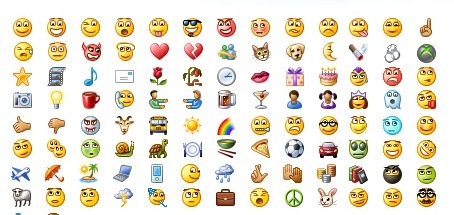
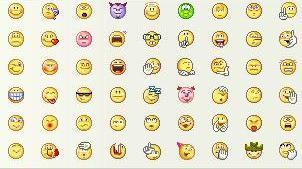
Unique thing is the fact that there are several alternatives to these emoticons. Some people mark Yahoo!’s emoticons as their favorites, while others are so familiar only with Blackberry’s.

I. Blackberry Messenger
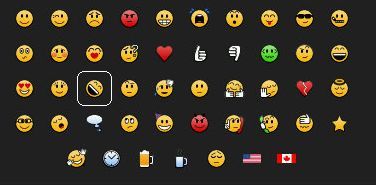
Bbmblackberryemoticons

II. MSN

Windows_live_emoticons_2010_by_mxiamxia

III. Yahoo! Messenger

Yahoo-emotions

Somehow, different developers convey different expression and leave different effects on the readers. ‘Smiling’ on Yahoo! has a slight difference with ‘smiling on MSN, for example. And this is an interesting phenomena that I’d like to explore more about.

Second interesting fact that lures my attention is how there are people who are very attached to these emoticons they can hardly write any single thing without them whereas there are ones who do not like using them at all. Not to mention that there is an accepted assumption that (assuming you haven’t met both), people who use emoticons are friendlier than those who don’t.

I bet the word ’emoticon’ is a portmanteau from ’emotion’ and ‘icon’. Probably because these icons emit certain emotions. But does that mean icons showing only certain goods like rose or clover can’t be called ’emoticon’? Who invented such portmanteau anyway?

(You might want to sue me because this post has more questions than it provides information. Sorry. Happy Saturdating!)

Hedgehogs’ Dilemma

(This time the credits go to Halimun Muhammad and his Facebook note.)

Hedgehog

“Look at those cute furs–wait. What?”

Imagine yourself as a hedgehog, irresistibly cute yet so ‘edgy’ that anyone would have to think twice before getting too close because they don’t want to get hurt. You might survive without problems during the Spring, Summer, or even Fall, but when the breeze of Winter comes, you might need to consider having friends to warm up together.

The hedgehog dilemma was first coined by a German philosopher named Arthur Schopenhauer to portray mankind’s constraint in social relationships. In his metaphor, a group of hedgehogs are assembling to feel warmer in the Winter. However, given their thorns as ‘borders’, they should keep a certain distance so that nobody would hurt one another.

Schopenhauer

Arthur Schopenhauer (1788-1860)

His main argument was that human’s need of social relationships will always clash with our basic characteristics to hurt one another. This analogy later became popular in psychology after quoted by Sigmund Freud himself. The result of these two contradicting natures is a dilemma all and every man should face. In most cases, mankind ‘deal’ with the dilemma through creating ‘safe space’ where they can interact with other men without getting hurt. ‘Politeness’ as well as ‘good manners’ are two essential tools to stay secure. There are, however, people who ‘has enough warmth in themselves’ and opt to create huger space–by completely restraining themselves from social lives. A trauma might be one good reason to commence such behavior.

The villains in most superhero stories offer us alternatives: ‘to abandon free will’, ‘to be independent’, ‘to focus on individuality’, as well as other indicators that separate one human from their ‘social-ness’. The conflicts of loneliness would then vanish beacause ‘all are one’, and ‘one is all’. This is almost similar to the action of peeling these hedgehogs’ thorns.

The question would then be, as quoted from Halimun,

Apakah perbedaan selalu menjadi duri yang menyakiti sehingga harus ada jarak atau durinya harus dicabut? Bukankah landak sebenarnya bisa melipat duri mereka sehingga bisa berkumpul sedekat mungkin tanpa saling menusuk?

(Do differences always hurt like thorns so that there should either be a space or peeled? Can’t the hedgehogs bend their thorns so that they can assemble as close as possible without being afraid of pricking one another?)

How can we, human, hold one little hedgehog in our hand and don’t bleed? Does that mean we got tougher skin? Can’t the hedgehogs use some ways to make them immune towards their own ‘edgy’  thorns?

I consider myself as one pessimistic hedgehog who prefers to not let myself wounded by creating ‘enough space’ from others, but not too wide indeed. I still consider myself friendly as I always try to be as cordial as possible. There are, however, people who are more ‘socially optimistic’ and ready to make new friends and have bonds with new people.

What do you say?

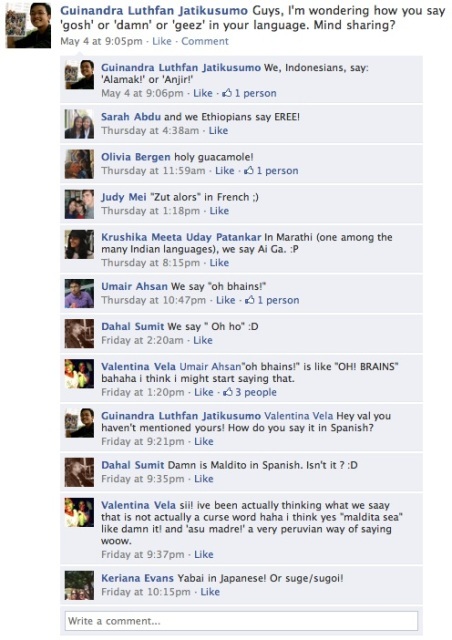
Holy Guacamole!

I’ve been frequently using the phrase during the past week and plausibly left some people questioning on what it means. Truth be told, it has no meanings.

Geez

According to Dictionary.com, the word ‘word’, means:

A unit of language, consisting one or more spoken sounds or their written representation that functions as a principal carrier of meaning.

It is punctuated that a word per se is a ‘carrier of meaning’. Nevertheless, this ‘meaning’ does not have to be explicit. In other words, there are words whose meaning hides somewhere between layers of understanding. Human kind is such an interesting species that can, believe it or not, communicate without basic agreement on which means what.

Take, ‘alamak’, for instance. No Indonesian nor Malaysian can help you comprehend what it means. However, each and everyone of them knows when they can use such expression. We have gah, meh, woot, and more words to tell people that you’re surprised, words to show people that you’re amazed, but we can’t actually define what these words ‘mean’.

It is the privilege of human beings to acquire and use complex systems of communication–way more complicated than a bee-dance is–and it’s called language. Be proud to have it.

I Hate Translations

“Translation is like cruelly mutilating a human’s body into parts and rejoin them afterwards.” Jean Paul Sartre, Les Mots

Let’s skip the ‘this-might-not-make-sense-to-you’ appetizer and get to the main meal. Translation, as how Sartre (paradoxically rendered from French) opened this post, is a highway shortcut for people who don’t have the high-motivation to take the long, winding road a.k.a. ‘comprehend literatures–or speeches–in the purest form’. These are people who don’t have time to learn languages, who don’t care if they might misunderstand some part of it as long as they have the raw apprehension.

Translation

“Insert beautiful shapes and I’ll transform them into new, shapeless ones!”
said the machine.

Surprisingly, I’ve met several exceptional minds who prefer to take hard lane. A teacher of mine, Mas Iqbal, spent at least 6 months studying German in order to understand Marx’s Das Kapital. Many others probably go to Kairo University, learn Arabic and everything before they have the holistic comprehension when they read the Quran.

Translation, my friends, is a semantic crime. No two words in different languages are ever completely interchangable. I hardly understand how translators have the heart to kill a sentence’s truest meaning and offer some shallow substitution. To my eyes, translation is like breaking a sentence into pieces and trying to rebuild them with weak glue. I always believe that there are cultural and historical aspects behind vocabularies–which mostly aren’t comparable in other nations’ chronicles.

However, getting your ideas translated to a number of languages (let’s call Dee’s Supernova or Ayu Utami’s Saman) is inevitably an honor for writers. To that we–I–can’t deny. (Not to mention the fact that I first met the magic world of Harry’s at my 3rd grade through bahasa Indonesia and not English.) Translation, hence, is an addictive yet destructive drug.

Make Your English More Powerful, With:

(Was once was one of The Jakarta Post I.M.O.’s top blogposts)

1. Better dictions

Choice-of-words is very crucial in composing a good writing. Do not even dare to think of belittling its influence.

However, this doesn’t mean that you should sophisticate every single word and force people to think that you’re that knowledgeable. In picking one of those words on the thesaurus list, consider these points:
(1) What you’re writing about.
(2) Who’s gonna be your readers.

If you want to talk about global warming to first learner kiddo, ‘melting ice cream’ would explain much better than ‘leak in the ozone layer’ or ‘increasing temperature’.

Dictions matter especially when you play with emotion. Consider this stupid confession:

“You can make me laugh out loud like a crazy lunatic or make my heart beat faster because of your sexiness or simply melt me with your cuteness and I love you. All of you.” (courtesy of a friend)

To this uber-literature English one:

“Other men said they have seen angels, but I have seen thee, and thou art enough.” (courtesy of Mr Moore)

Mr Moore has did a very good job there, using super ancient English and everything, but unless you’re an English literature student, I guess you’ll understand my friend’s love to his girlfriend better than Mr Moore’s to Mrs Moore. Am I right? The way you convey your message does matter. So, dictions.

2. Correct tenses

This is what most people think: How can Dad expect me to conquer those 16 crazy tenses! They’re made for non-humans!

Tenses1j

This is what you should think: Tenses are made to help your readers understand what is happening when, sometimes beyond what is there, to another dimension.

Compare:
a. Bull kicked Bill’s butt.
b. Bull kicks Bill’s butt.

The first sentence, using a past tense, infers that Bull once happened to kick Bill’s butt. Accidentally or in purpose, but the activity was never repeated unless you add ‘again’. In sentence B, ‘kicking Bill’s butt’ apparently has become Bull’s regular habit and I have my deepest condolence to Bill for that.

By just putting ‘ed’ in place of ‘s’ in that sentence, you can make your reader understand Bull probably better than he understands himself. Befriend tenses!

You can also see how saying ‘I love you’ would give a different effect from teliing people ‘I loved you’.

3. Priorities

Decide what you want to say first and then after. Priorities make dynamics to your writing. Sample of priority options:

a. Share a story and give lessons afterwards.
b. State an idea and give a story to support your argument.

4. Spelling check

Spelling is probably not that important because people will eventually understand as long as your structure of sentence is correct, but some pedantic or spelling-nazis may hate you forever when you misspell. Plus it’s not that hard to have a spell-check. Leave the burden to Microsoft Word or Google Chrome.

5. A talking keyboard

Just kidding (it’s not even funny, blamey). I meant jokes. Tickling lines will encourage your readers to continue and and finish until your very last sentence.

“Now open a new document on Microsoft Word and start typing down!”